
OIE Process
Intake Meeting
Upon Notice, a staff member may send an Outreach Letter to the Complainant, and an Intake Meeting may be held. During the Intake Meeting information is gathered, options are reviewed for supportive measures, parties’ rights are outlined, and there will be a review of the resolution procedures. The Intake Meeting does not have any influence on the investigation or the outcome of the investigation, but the Title IX Coordinator will use the information to determine which resolution process is appropriate.
Formal Complaint
For Title IX reports only, a Formal Complaint, sent via an online form provided by the Title IX Coordinator, is filed by the “Complainant” and is an official request for the University to review and take possible action on the reported allegations discussed during the Intake Meeting.
Informal Resolution
If both parties agree, an informal resolution may be an option. Informal resolutions at NU are conducted in a facilitated discussion style, generally by the Office of the Ombuds, without formal investigation. This must be approved by the Title IX Coordinator in compliance with federal regulations and NU policy’s which may have specific violations that may not be resolved through Informal Resolution. An Informal Resolution does not include a finding of responsibility. If either or both parties no longer wish to pursue the informal resolution prior to a signed resolution agreement, the case will be referred back to the Formal Grievance process where it had left off prior to the Informal Resolution process. The agreed upon Informal Resolution outcome must be approved by the Complainant, the Respondent, and the Title IX Coordinator. Once the Informal Resolution outcome has been signed by all parties, the matter can no longer be referred back to the Formal Grievance proceedings.
Investigation
Once a complaint has been filed, an Intake Meeting is conducted, and an Initial Assessment is made by the Title IX Coordinator, who will then determine next steps. OIE Investigators will interview the Complainant, the Respondent and any witnesses relevant to the investigation. Complainants and Respondents may have an Advisor of their choosing present or have a trained NU advisor assigned to them. Investigators strive to conduct their investigations promptly, thoroughly and equitably. Once the investigation is complete, relevant information gathered will be shared with the parties, Complainant and Respondent, in a comprehensive Draft Investigation Report. Parties are given a review period to provide any written edits to their own statements in the report for the investigators. A completed a Final Investigation Report, along with relevant evidence, is then ready for review by Decision-Makers and hearing.
Hearing
A Hearing is conducted by a panel of NU trained Decision-Makers. In certain circumstances, prior to the hearing, the parties may choose to meet with the Panel Chair to review the hearing process, expectations, and an opportunity to ask questions. Depending on the process, at the hearing, the Complainant and the Respondent may have an opportunity to provide an opening statement and then answer questions from the hearing panel followed by questions by the other party’s Advisor. Witnesses participate in the same manner. Again, depending on the process, if closing statements are made, the hearing panel deliberates privately and provides a written outcome to all parties.
Appeals
Both the Complainant and the Respondent may request to appeal the decision in writing to the Title IX Coordinator. If an appeal is submitted, the other individual will be notified and provided with a copy of the appeal and will be given an opportunity to respond to the appeal in writing. Grounds for appeal include:
- Procedural Irregularity
A procedural irregularity affected the outcome of the matter; or - New relevant evidence
New evidence that was not reasonably available at the time the determination regarding responsibility or dismissal was made, that could affect the outcome of the matter; or - Conflict of Interest
A member of the ERP team involved in the resolution had a conflict of interest or bias for or against Complainants or Respondents.
For additional questions regarding the Title IX process, please contact the Title IX Coordinator at [email protected]
OIE Process Map
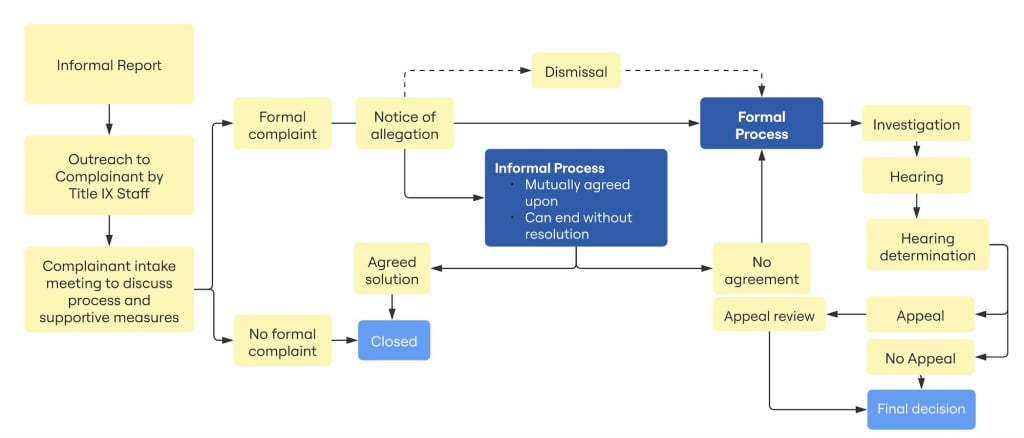
*This is a summary of one process used by the OIE
You’ve Received a Letter
The Office of Institutional Equity (OIE) utilizes Maxient, a confidential case management software, for email correspondence with students and staff. A letter from the OIE is official correspondence on behalf of NU, and in order to access the content students must be able to log-in to their student account.
When you receive an email notification, you will see the following message in the text field:
THIS IS AN OFFICIAL CORRESPONDENCE FROM NATIONAL UNIVERSITY
This is not spam. An important letter has been issued to you electronically. Upon clicking the link below, you will be taken to a screen displaying your name and requesting an access code to ensure confidentiality. Please confirm that your name appears on the screen and then enter your current/former student/employee ID number as the access code. If you are receiving this notice in your capacity as a leader of a campus organization, you should contact our office immediately to request the appropriate access code for your organization.
Your letter will appear in PDF format and should be printed or saved for your records. It will remain accessible through this link for 30 days. If the letter fails to appear, you may need to use a different computer or install the free Adobe Acrobat Reader. If you continue to experience difficulty accessing your letter or wish to confirm the legitimacy of this message, please contact our office at (858) 642-8087.
The Content of the Letter will depend on the nature of the concern provided to the university and may include a number of attachments, such as policies, resources, and what to expect, etc. A letter may also be sent to ask to meet with staff of the OIE if it is believed that someone may have additional information to provide about the concern raised to the university. In the letter there will be information on how to contact the OIE to schedule a meeting to discuss the concern raised. For additional details, see the OIE Process and the OIE Process map on this page.
ERP Members
Title IX Coordinator
- Heather Tyrrell, M.S., CCEP
Hearing Officers
- J.B. Robinson, PhD
- Michelle Vandenbergh, MS
- Sara Kelly, EdD
- Matthew Bruce, PhD
- Julia Harvey, MSOL, SHRM-CP
- Melissa Caridi, MS, SHRM-CP
Investigators
- Robina Smith, MBA
- Sandra Garcia, MA
ERP Advisors
- Dr. Penelope Keogh
- Katherine Risk
- Natalia Gaeta
- Vivian Becerra
- Debbera Guglielmo
- Ricardo Ortega, PhD, MBA, CCEP
Required Trainings
- Title IX Coordinator & Administrator Level Three Certification
- DEI Practitioner One
- Informal Resolution Level One: Foundations Certification
- Title IX Coordinator & Administrator Level Four Certification
- NPRiMer: Preparing for the Upcoming Pending Title IX Regulations: Training and Certification Course for Higher Education
- Title IX Coordinator Foundations: Gender Equity for Higher Education Certification (2024 Regulations)
- Title VI Compliance Foundations Level One for Educational Settings Certification
- Title VI Compliance Foundations Level Two: Best Practices for the Title VI Coordinators in Educational Settings Certification
- Live Hearings for Higher Education Certification
- Managing Appeals Seminar
- Civil Rights Investigator Level One Certification
- ADA/Section 504 Foundations for Higher Education
- Investigation Report Writing
- Title IX Coordinator & Administrator Level Two Certification
- Title IX Hearing Officer & Decision-Maker Certification
- Title IX Coordinator & Administrator Level One Certification
- Title IX Decision-Maker for Higher Education Certification
- Title VI & Civil Rights Investigation Foundations Level One in Educational Settings Certification
- Title IX Coordinator & Administrator Level One Certification
- Investigation Report Writing
- ADA/Section 504 Foundations for Higher Education
- Writing Outcome Rationales Workshop
- Title IX Hearing Chairs Certification
- Title IX Coordinator & Administrator Level One Certification
- Civil Rights Investigator Level One Certification
- ADA/Section 504 Foundations for Higher Education
- NPRiMer: Preparing for the Upcoming Pending Title IX Regulations: Training and Certification Course for Higher Education
- Title IX Coordinator Foundations for K-12 Education Certification (2024 Regulations)
- Managing Intake, Jurisdiction, and Dismissals Workshop
- Writing Outcome Rationales Workshop
- Assessing Climate Seminar
- Investigation Foundations for Higher Education Certification (2024 Regulations)
- Supporting Pregnancy, Parenting, & Related Conditions Workshop
- Applying Policy in Investigations & Determinations Workshop
- Title VI & Civil Rights Investigation Foundations Level One in Educational Settings Certification
- Live Hearings for Higher Education Certification
- Managing Appeals Seminar
- Title IX Coordinator & Administrator Level One Certification
- Title IX Investigation Foundations Level Two: Investigation Skills & Report Writing for Higher Education Certification
- Implementing the 2024 Title IX Regulations for Higher Education
- Title IX Coordinator Foundations Level One: Sexual Harassment for Higher Education Certification
*Training records are available for the previous 5 years.