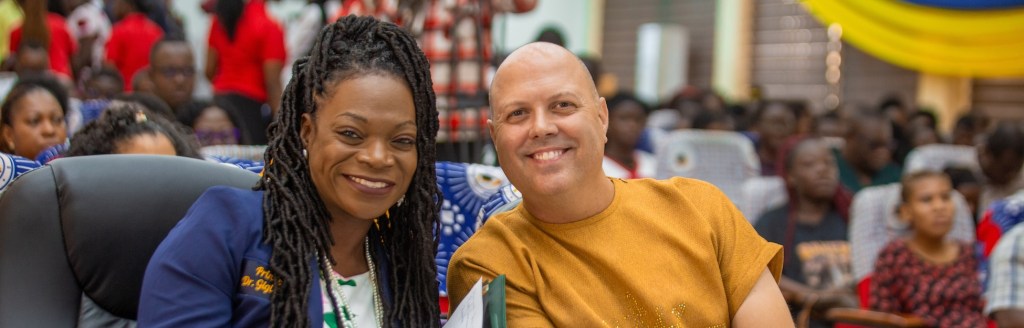
Empowering Education: Journeys in Leadership and Literacy
Discover the transformative power of education and leadership as you join us for an inspiring conversation with our own Dr. Gary Walker-Roberts and Dr. Gigi Darko. Dr. Gigi, an educator and change maker, uses literacy as a key to unlock potential and eradicate poverty on a global scale. Together, we explore the profound impact of their collaboration, which has inspired the Legacy Leadership Summit, reaching and transforming communities through education worldwide.
Embark on a cultural exchange adventure in Ghana, where educators from the United States, Ghana, and Nigeria gathered to share and learn innovative educational practices. Experience the profound joy of bringing education and digital literacy to rural Ghanaian communities through the eyes of Dr. Gigi and her dedicated team. As we reflect on the lasting bonds formed and the significance of representation, Dr. Gigi and her colleagues leave a legacy of hope and achievement, igniting imaginations and creating opportunities for brighter futures.
Show Notes
- 0:05:22 – Legacy Leadership Conference and Doctoral Connections (125 Seconds)
- 0:17:52 – Ghana Promotes Local Language Education (98 Seconds)
- 0:26:50 – Empowering Education Through Technology (97 Seconds)
- 0:31:43 – Digital Literacy in a Rural Village (146 Seconds)
- 0:42:43 – Empowering Ghanaian Education Through Collaboration (156 Seconds)
- 0:54:11 – Embracing the Whole Student Experience (86 Seconds)
0:00:01 – Announcer
You are listening to the National University Podcast.
0:00:08 – Kimberly King
Hello, I’m Kimberly King. Welcome to the National University Podcast, where we offer an holistic approach to student support, well-being and success: the Whole Human education. We put passion into practice by offering accessible, achievable higher education to lifelong learners.
On today’s episode, we’re discussing the Legacy Leadership Conference and we’re talking with Dr. Gary Walker-Roberts, an assistant professor in the Teacher Education Department of the Sanford College of Education at National University. Dr. Gary earned a Bachelor of Arts in Ethnic Studies, gender and Sexualities at California State University, East Bay, and thereafter Dr Gary earned a Master of Arts in English at Arizona State University and obtained a Doctor of Philosophy in Education with a specialization in online teaching and learning. In the national university system, Dr. Gary enjoys their role as a professor, dissertation committee chair and subject matter expert, where they successfully facilitate doctoral candidates to reach their terminal degrees. Lastly, Dr. Gary is passionate about traveling abroad to encourage education and lifelong learning. Dr. Gary has traveled to many countries, such as Colombia, Thailand, Ghana, Kenya, and Nigeria to teach students English and digital literacy skills.
Also with us today is Dr. Gigi Darko. Dr. Gigi is a visionary educator, global leader, and principal of PSIS 184, a thriving K-8 public school in Brownsville, Brooklyn. Since 2024, she’s transformed schools into joyful, equitable, and vibrant spaces that honor every child’s identity, culture and voice. In 2025, Dr. Gigi was named Principal of the Year for her innovative instructional leadership, data-driven design and ability to inspire growth among staff, students, and families.
Her influence extends beyond New York City, and in June of 2025, she led and presented at the Leadership Summit at Cape Coast University in Ghana, uniting global educators, including her department chair, Dr. Walker-Roberts, to share best practices in literacy, innovation and community leadership. They visited seven African cities and two countries on an edu-tour. Her passion for global equity inspired the Legacy Library in Kpando, Guyana, established in 2023 and expanded into a digital center in 2025, serving hundreds of students. Dr. Gigi earned her PhD in global education from National University in 2025, strengthening her commitment to empowering communities locally and internationally. Dr. Gigi’s leadership embodies purposeful, equitable education, shaping schools and futures, and we welcome you both to the podcast. Sorry that was a long-winded introduction, but, wow, very impressive on both ends. So thank you for being here.
0:03:17 – Doctor Gary Roberts-Walker
Thank you Kim. It’s great to be here.
0:03:19 – Kimberly King
Wonderful. Why don’t you both fill our audience in a little bit on your background and your well, your mission and your work? Really your mission, and it is very clear in this intro. But I want to hear from you, both of you, your mission.
0:03:34 – Doctor Gary Roberts-Walker
Thank you, Kim. You know my mission is certainly embodies exactly what you just read about Dr. Gigi. Dr. Gigi was my doctoral candidate at National University and one of my missions is to really help guide and collaborate with the doctoral candidates to earn their terminal degrees and to listen to their passion and to listen to their lifelong drive. And I heard Dr. Gigi’s loud and clear during the dissertation phase, and she is so committed to making sure literacy is top of mind around the world and I just fell in love- not only with the topic but also with Dr. Gigi.
So today just really makes me smile to see that my passion, through what I do it really inspires people and to see the work firsthand around the world is just unbelievable. So you know that is my passion and I’ll continue doing that at National University. And you know, Dr. Gigi was just a shining star, and it’s such a privilege to be here with her today.
0:04:40 – Kimberly King
Aw, I love that.
0:04:41 – Doctor Gigi Darko
Thank you, Dr. Gary. Thank you, Dr. Gary and I are just kindred spirits. We really are. My mission is to promote literacy wherever I go, whether it’s Brooklyn, whether it’s Kpando, whether it’s Ghana, Nigeria, hopefully Thailand soon or Hawaii, my mission is to really promote literacy. I believe it is the catalyst to end poverty and to open opportunities for all children, and so finding a dissertation chair like Dr. Gary, who can bring that out in the most professional and educational way, was a dream.
0:05:21 – Kimberly King
Oh. I love it. You’re both making a difference here, one step at a time, one student at a time. So today we are talking about the Legacy Leadership Conference, and so, Dr. Gary, I’m going to start with you. How do you two know each other and you did kind of explain that just now, but how and where did you meet? And let’s talk a little bit more about your background.
0:05:42 – Doctor Gary Roberts-Walker
Yeah, so at National University we do a wonderful program called the boot camp, dissertation boot camp and this is where we bring doctoral candidates or doctoral students together and we have intensive four-day workshops, and you know, a place where we can collaborate with the students in person, you know, because the individualized model certainly is online, so it’s more asynchronous. So this gives an opportunity for us to come together synchronously. And in the room walked Dr. Gigi, Gigi at the time, and Gigi walked into boot camp and the smile and her energy just really captivated the room and I immediately thought, hmm, I hope that she is in the school of education, the Sanford College of Education, and certainly she was. And so I kept my eye on her at boot camp and, you know, Gigi just brought that wonderful smile and wonderful energy.
And once I found out that her specialization was international education, we had this conversation and Gigi worked on really shaping her problem statement, purpose statement, and I could hear the problem that she wanted to address, but a different alignment with her passion. So I kind of let that play out and I said, hey, let’s you and I keep in contact and why don’t we certainly, you know, talk about your problem statement after boot camp and we developed that relationship at boot camp and here we are today talking with you, Kim, so it’s just been a full circle. Wonderful, you know, situation.
0:07:24 – Kimberly King
I love that you said I kept my eye on her. So, Dr. Gigi, what was your dissertation topic?
0:07:30 – Doctor Gigi Darko
So I did a qualitative narrative study on how books influence literacy, how it influences education, and, going back to the question that you asked Dr. Gary, early on, my dissertation topic was not how books influenced literacy, it was best practices in global education. And so, you know, when Dr. Gary and I think back to that moment- I got a phone call from Dr. Gary and he said, Gigi, we need to talk. And then he said, you know, when you mentioned best practices in global education, your tone sounds very professional and it’s reading- But when you talk about giving children access to books and how books can influence literacy, your voice shines.
And I really think that you should consider changing your dissertation. You don’t have to do it right now, but think about it. You know when Dr. Gary says think about it, you already know what he wants you to do. And I hung up from that phone call and I called my best friend like can you believe this department chair? He wants me to change my dissertation topic! And she said do you trust him? And I said I do. And the rest is history.
0:08:51 – Kimberly King
Wow, and you know what I think, just on that note- I love that, I love that backstory and I appreciate you sharing that with everyone. But you know, sometimes life happens so quickly.
So for you, Dr. Gary, to really, you know, quietly hear where her passion was, that’s outstanding. And look at you now. So I love that you shared that, and how you chose that dissertation topic. So I see, you know, really, we’re all here today talking about this and Dr. Gary kudos to you. So how did you know how to guide Dr. Gigi to this topic? I guess you kind of just opened the door to that, but you heard her passion.
0:09:33 – Doctor Gary Roberts-Walker
Yeah, I think you hit the nail on the head, Kim. I really was quietly listening. I think it’s important for dissertation chairs to listen to the student and certainly they want to impress their chair, but just listening to their passion, they have to marry this topic for two and a half years, so you know, they really have to be passionate about it. So you know, I think you got it right, Kim. It was just listening to her and then really convincing, like you heard Dr Gigi say, you know, don’t give me a quick yes or no now, think about it and then come back to me, right? And that’s exactly what she did, and I’m glad we did it, because you can still hear her passion in her voice. And when she talks about the legacy leadership conference that we attended in Africa, or actually she hosted in Africa.
0:10:22 – Kimberly King
So talk about it. That’s a perfect segue for the at the University Cape Coast right, and so I do. I would love to learn more, as do the listeners, about the Legacy Leadership Conference.
0:10:34 – Doctor Gigi Darko
So my husband and I built the first standalone elementary school library in Kpandokana. The ribbon cutting was in 2023. Prior to that, in 2019, we did a give back and we were able to give- We started out just thinking about four students, but we ended up giving 1,561 students books, life-changing experience that I promised them I’d come back and build them that library, and we did. In 2023, we built them that library and then I promised the educators there that I would come back and host a conference so that I can teach them to leverage the resources that we’d given them. And so that’s really where the Legacy Leadership Conference came, was birthed.
We did a collaboration with the University of Cape Coast and because we were offering this, these workshops, they thought that their graduate students would benefit from it as well, and so we ended up doing workshops on special education. We did workshops on artificial intelligence, we did workshops, of course, on the science of reading, we did workshops on mathematics as well, and we did workshops on leadership, and so that’s where the Legacy Leadership Conference began.
0:11:56 – Kimberly King
Again, that passion that Dr. Gary is talking about, it really does shine through. And so, Dr. Gary, how did you come to get involved with this Legacy Leadership Conference?
0:12:06 – Doctor Gary Roberts-Walker
Well, so Dr. Gigi, after earning her PhD, came back to me and said I have this idea, and it’s in the works and I’m collaborating with the University of Cape Coast, and I would love for you to come and keynote speak for me at the conference. So I did the keynote speech on the first day and you know, it was just absolutely amazing and just like Dr. Gigi trusted me, I trusted Dr. Gigi.
She said I want to travel with you to Ghana, Africa. I had never been. I had been to the continent of Africa before, but not to Ghana. So we had lots of conversations about what the expectation was, what the leadership conference was all about. And it didn’t take me long. I did not have to hang up and go talk to my girlfriend. I gave her an immediate yes. So there I was, packing my bags, heading to the University of Cape Coast in Ghana, Africa, to perform my keynote speech in Ghana, Africa to you know, perform my keynote speech.
0:13:06 – Kimberly King
I love it. What were some of the topics you spoke about during your keynote?
0:13:11 – Doctor Gary Roberts-Walker
Great, great question. So you know it was an audience of educators so at the university, and their dreams were to become teachers. And so, you know, Dr. Gigi and I collaborated. We wanted to talk about, certainly, the imposter syndrome. I think that’s something that you know many, many students struggle with and lifelong learners struggle with is, you know, do I really have those skills? Am I an imposter?
And one thing that I wanted the students to know is the antidote to the imposter syndrome is self-trust. So, some of the techniques that I wanted the students to certainly recognize are those silent conversations that creep up and the self-doubt starts to come in. So, first, silencing your internal chatter, but then also, if you’re having an external chatter with somebody, then you really want to make sure that you are cognizant of that to redirect the conversation.
One of the last techniques I wanted to teach them was mirror work. So you, you know one thing that I learned is when you are, you know, suffering a little bit from imposter syndrome, walk up to that mirror, look at yourself eye to eye and have those certain, certainly the conversation, to really elevate and give confidence and self-motivation. So if you can self-motivate yourself, you can definitely overcome imposter syndrome, and I wanted them to know that they belong in that seat, they belong in that classroom and they will, just like Dr. Gigi, inspire the next generation of students to not only read, but to become the leaders of their country.
0:14:52 – Kimberly King
Beautiful. I love that. So, you kind of really talked a little bit about this. But, Dr. Gigi, I’m going to ask you about the goals of the Legacy Leadership Conference there at the University of Cape Coast conference there at the University of Cape Coast.
0:15:10 – Doctor Gigi Darko
So, as Dr. Gary mentioned, we did come with about 12 additional- most of them were American right, except for Dr. Gary. So we traveled it was 14 of us and we traveled to Ghana and one of the goals was, first, I wanted the graduate students and the teachers to experience Dr. Gary, as I had experienced him, to experience how effective and how impactful it could be to have someone in leadership talk to you and pour into you about leadership. So that was a goal and I believe we achieved it. There are videos online that you know show how impactful his keynote speech- their keynote speech was.
Another goal was having the participants that traveled with us learn from Ghanaian educators. Oftentimes we see countries like Ghana or Nigeria as places where we’re going to give them something or we’re going to teach them something, but I wanted to turn the tables and really set a goal, set an expectation that we’re there also to learn. We have so much to learn from Ghanaian and Nigerian educators. And then, certainly a goal because it is a conference- was for us to discuss innovative practices, best practices. You know, the science of reading, artificial intelligence, and what that looks like in education in the States, the mathematics and special education. That was a really, really big topic.
We had our guest educational leader, Natalie Francois. She did a workshop on special education and they invited her back less than three months later to continue the series that she started over there. My assistant principal, Denise Huggins, did a workshop on the science of reading and it was phenomenal. My deputy superintendent was the co-keynote speaker to Dr. Gary. She presented on day two and she spoke about leadership and what that looks like in education.
And we also had a math coach, Zarema Bravo, at the time she also presented on mathematics. And then my dear husband, who sort of started all of this- he presented on the artificial intelligence. So we had quite a few workshops going. We had keynote speaking at the beginning and then we had some Q&A and then we had the workshops and then we all came together to summarize and to talk about the day and then discuss what the next steps were.
0:17:52 – Doctor Gary Roberts-Walker
And, if I could just jump in there, they you know the University of Cape Coast were such excellent hosts. They rolled out the red carpet for us the moment we stepped on campus, throughout the entire conference.
But one of the other things that I wanted to speak about that we heard, you know, we put on our big ears and listened as well, and they were talking about culture, the Ghanaian culture and the language, and when the students go to school, they’re mandated to speak English. So they felt that the culture was, you know, being a bit erased, and so I wanted to speak about today that I just got some great news that Ghana replaces English with local languages, and what I got from one of the students said that Ghana has introduced a new education policy promoting the use of local languages and basic schools alongside English.
The goal is to help children learn faster, understand better and stay connected to their culture, and we heard that loud and clear at the conference. So, you know, this was just a great, a wonderful and a major school policy to help children learn better in their mother tongue. And we were practicing, right, Dr. Gigi. So, you know, really talk about cultural relevancy and learning the language alongside of them to really make them feel comfortable during this collaboration was important.
0:19:22 – Doctor Gigi Darko
That’s Gary. Medaase pa. That is thank you in Twi.
0:19:28 – Kimberly King
Oh, I love so you must- You must have had translators there when you were presenting, but it sounds like you had some great takeaways and aha moments there as well, with learning that new language.
0:19:39 – Doctor Gigi Darko
Well, we didn’t have translators. They spoke fluent English. Read, spoke and wrote fluent English. Professor Douglas and Professor Rosemary did such a wonderful job creating a panel of experts so that the audience can, you know, ask their questions, and we had such great, rich discourse around literacy and what that means to the community. It was great.
0:20:06 – Kimberly King
Oh, wonderful. So what were- Did you have some specific other aha or takeaway moments, some wow moments? It sounds like the whole conference was this way huh.
0:20:16 – Doctor Gigi Darko
The entire conference was mind blowing. So many great relationships were formed. One of the aha moments, as I mentioned before, was the need for more special education conversations, discourse, and workshops. Teachers really needed a space to talk about what they, what they are faced in classrooms and how they can address the needs of their students, whether they are special education students or students with disabilities, whether they are and this is just not physical disabilities.
We actually had a teacher who she had a physical disability and she spoke to us about where she got her confidence from. She got it from her mother and how she was taught to correct the people in her lives. That this part of me is not all of me, and I have so much more to offer. And because she’s able to do that for herself, she can teach her students to do it for themselves as well. So it was so impactful, not only for us receiving from them, but also for them to hear what they had to say amongst themselves.
So that was a big aha moment for me that sometimes you do conferences and you’re thinking, okay, you’re going to pour into others, and you really take for granted how much they pour into you and how much they pour into each other.
0:21:47 – Kimberly King
Wow, I love that. Again, it comes down to listening too, and just you know you’re reading the room and you’re hearing them as they are to you, so that’s beautiful. I understand you visited the Cape Coast Slave Castle after the Legacy Leadership Conference. Can you tell us a little bit more about that experience after the Legacy Leadership Conference?
0:22:07 – Doctor Gigi Darko
So I make it a point every time someone travels with me to Ghana to either visit Elmina Castle or Cape Coast Castle. They’re one of the largest slave castles that are still mounted and still up in West Africa, and I do it for so many reasons. I feel like it is a life-changing experience because it really you still sense the evil that took place in that castle and only when you have stepped foot in it and heard the voices of the tour guide and what our people have endured can you really begin to. The wrong word is understand, because how can you understand such evil? But you can begin to comprehend the story that is told that took place in that castle.
0:22:57 – Doctor Gary Roberts-Walker
Yeah, I mean, it’s very emotional to speak about it. You know, and it’s very difficult on a podcast to really go into the real depth and gravity of what. You know, the emotions you feel walking in and being toured around the slave castle. You know, my husband is African American and my mother-in-law as well, and you know I certainly could put myself in a situation where the horrible- like Dr. Gigi was saying- the horrible actions and to look in a room and to see what took place in those rooms.
And one of the biggest impactful moments was walking through the Door of No Return, which is a big wooden door. That was the last place you know they saw before they were put on ships and shipped. So you know, let’s save that conversation for later. But what I would like to say is, you know, as you read, I have my bachelor’s degree in ethnic studies and I remember my teacher talking about this castle and I knew then, I said I will get there one day and I’m very, very thankful for Dr. Gigi for touring us through that castle and it was profoundly impactful. So thank you, Dr. Gigi.
0:24:36 – Doctor Gigi Darko
You’re welcome.
0:24:38 – Kimberly King
Wow, well, it is indescribable. So I appreciate you, you know working through this and really sharing this with us as well.
0:24:58 – Doctor Gary Roberts-Walker
Can- May I just say one other thing, it was so impactful, but the message I would like to say to the audience- everyone, everyone, doesn’t matter what race or culture you are, should visit, and you know, “understand” again, is the wrong word, Dr. Gigi, you’re right, but just feel the impact of what history you know, is and has, and the lasting effects of it that we still are battling.
0:25:23 – Doctor Gigi Darko
Yeah, for sure, absolutely.
0:25:24 – Doctor Gary Roberts-Walker
That’s what I would say to the audience.
0:25:26 – Kimberly King
Well, and just from your background too, Dr. Gary, and all the travel and both of you, I think that’s the key to that legacy of learning and being a lifelong learner. Asking those questions about the history, what happened and where we were then, where we are now, and for you to be right there in the travels and seeing that, that’s just yeah.
0:25:51 – Doctor Gary Roberts-Walker
Beautifully said, Kim.
0:25:53 – Kimberly King
It’s so important to witness this to the degree that we can. How was the long journey to Kpando? And then, what was your team’s goal when you arrived at that primary school?
0:26:06 – Doctor Gigi Darko
So it is a five hour long ride and the roads are-
0:26:12 – Kimberly King
Okay, wait, you land and then you’re another five hours on the journey.
0:26:16 – Doctor Gigi Darko
Five hour drive from the city. It is rural to say the least. [Laughter.]
0:26:22 – Doctor Gigi Darko
But we were all in good spirits. We were so excited, to say the least, but we were all in good spirits. We were so excited to see the children. The children were so infectious and so loving. So I want to say, for me that was the best part of the edu-tour was visiting the children, and my husband and I- we were able to raise funds. I authored four books, and I use all of that money for philanthropy work, every single dime and so we were able, you know, we opened up the library in 2023. And then we promised to come back and give them devices. And so we were doing the commissioning service for the digital center that we opened up.
And, because of where the library is situated, it’s not just a matter of getting some iPads and giving it to children. There is no light, there is no Internet, there is no service. So it’s really thinking about the full package If we’re really going to give them device and access to the Internet. It really is about thinking about how to make this sustainable for at least two to three years and then revisit to see what else they need.
So that was so mind blowing for me, but it was also very sentimental for my husband. My husband came from that school, and he learned to read at such a late stage in his life. Thank God now he’s an engineer, but that was really the catalyst, that’s what propelled us to do this, so that no other child will have to go without books, go without the imagination and the wonder of reading a book.
And so putting a device in the hand of a child and knowing that they have the same access as a child in the States or a child in Italy or wherever, it wasn’t only a happy time for the children but for their teachers, because they themselves did not have access to this.
So when they tell a child that such and such is happening across the world, they can show them. One of the books I read to the children was the Sisterhood of a Traveling Pan, and it talks about how, you know, during the pandemic, everyone was locked away in their homes, but an Italian girl and a Haitian, Ghanaian girl let this cornbread pan go back and forth and they were able to make happy times in the pandemic. Anyway, one of the children in Ghana read that book and it didn’t dawn on her that the pandemic happened to the whole world. She just thought that it happened in Ghana. So for her to see that it happened to us all, it just made it more real. And how impactful reading and access to books, how impactful that can be for a child, for children.
0:29:17 – Kimberly King
You know what-
0:29:19 – Doctor Gigi Darko
So I will let Dr. Gary-
0:29:20 – Kimberly King
Oh yeah, absolutely. I was just going to say a little key takeaway that you know, it’s true, we have to ignite our imaginations, and so that I love- that’s beautiful. And also, just, you know what we take for granted when you said even not having light or just the proper background or backdrop or that, just everything. So thank you for sharing all of that.
0:29:42 – Doctor Gigi Darko
Yes, you know, Kim, just because you said that and it reminded me when we were doing the commissioning service both times in 2023 and in 2025, a little girl- and I want you to visualize this a little girl- barefooted she had her beautiful African garb on, but she was barefooted for a reason. She read a poem that she wrote and the poem was titled Literacy Came to Our Village and she read it in front of the king and the queen that was there and she, you know, she talked about how the school was there for 75 years and they’ve had, you know, this event and that event, but nothing like when literacy came to their village, because it was the first time that they saw a room full of books that they had access to, that they can touch and take home and read and, you know, participate.
And that little girl is what sticks into my head every time we go back and we continue this work. It reminds me that it’s not just about books or a device. It really is about giving literacy, giving opportunities to children.
0:30:54 – Doctor Gary Roberts-Walker
Beautiful, I love that and you know, Kim, I was going to say you touched on one of the themes, so I’m going to answer in two parts. First, I’ll do the academic part. So, as you can see, this is why a narrative study was fantastic for Dr. Gigi, right, letting those children tell the story that she is broadcasting today. Secondly, that was one of the themes, if I do remember correctly, Dr. Gigi was the books that are brought in your, especially your book ignite curiosity, and a, you know, inspiration of what’s going on around the world beyond the rural village and Kpando, and I think that is just absolutely amazing that, Kim, you picked right up on that, so you would love Dr. Gigi’s dissertation.
However, with that same passion, Dr. Gigi told me about the visit to Kpando, that ride, you know, thank God, I was full of excitement and everything was new to me because it was definitely rural, and I grew up in the farmlands in upstate New York and this, you know, had nothing to compare to. But it was thrilling and just wonderful. And she tried to prepare me for when our van would pull up to the school. It was better than a Taylor Swift concert.
The children were in the village. They ran with the van. When we got out, they were full of love and hugs. And then there was decorum and we had the ceremony and they certainly gave great speeches. I was blown away by their speeches and their cultural dances and to see such a thriving community where everybody is helping everybody, right, and it just was just so amazing.
And one thing that I’ll pick up on, Dr. Gigi, that you know comes in a quote that I said after hearing her speak about this, and it is you know, giving a student a book or a laptop is an act of kindness, but teaching the student how to read and use that digital literacy is an act of love.
Because we could come to Africa, come to Kpando, and give them laptops, give them books, but if we’re not there to work with the teachers and to really teach the children how to have digital literacy and, as you read my bio, my PhD in online teaching and learning, digital literacy skills are very, very important around the world in the 21st century.
And these children were grabbing us, taking us to the computer, and I think we made national news, if I’m correct, Dr. Gigi, of the children learning, you know, alongside us, really navigating. Actually, to be honest with you a little secret, I think they were showing us some new techniques, and so it was wonderful. But to see their smiles and to see their passion to really want to learn how to use these computers and to see that they had computers in their village was just amazing.
So kudos to Dr. Gigi and all of the work, and her husband, Teddy. To hear that story from Teddy, to see Teddy return back to the village and inspire these children, right that you know you can. If you are learning how to read, if you’re learning how to write, you have a bright future. And I will tell you, every single student wants that bright future and that’s what we hope for them.
0:34:37 – Kimberly King
I love it. It’s a window to the world and it’s almost like it’s the same concept of you can cook for somebody or you can teach them how to cook or go fishing or hunting or whatever you know, wherever you get your food. But it’s really teaching those lifelong skills and that’s what you’re, that’s what you’re doing with that literacy. I love it- digital literacy. so how? What did, like the afterward- what was it like to see that commissioning of the digital library and their literacy skills afterward?
0:35:11 – Doctor Gary Roberts-Walker
Again passionate. But I want to go back to Dr. Gigi. One of the best things to see was National University makes a poster of the doctor’s study and she traveled all the way to Kpando. I mean this is a huge poster of you know, the problem statement, purpose statement, research questions, findings, the students’ narratives. We don’t disclose where she did the study, so nobody knows that, of course, but it is in like fashion of the rural village in Kpando and Dr. Gigi was able to show the students the study and then place it. She decided to leave it in Kpando and they put it on the wall. I’m getting goosebumps now.
And just to see the students looking at that and saying, you know what is, what does this mean? Right? And to see Dr. Gigi explain to them what that is and that they too could achieve, that was- I, I the pinnacle, right, like for a teacher, for a doctoral chair. This was just the moment and you know I have to give a shout out to Dr. Patricia Kennedy. She was the subject matter expert on Dr. Gigi’s committee, and you know without her this wouldn’t have been possible either, but you know she wasn’t able to travel with us. But I really would like to give her a shout out, because it was just, you know, her expertise that really helped seal that, you know, commissioning of placing this dissertation on the wall.
So just a lot of inspiration going around. And not only that. We did bring supplies- I think that was when we left them with gifts and we brought pencils and papers and notebooks and you know, just wonderful educational and life tools for them to use. And they, they just aided, they, they did not want to see us leave. I think, you know they ushered the bus in by running and then on the way out, they were being funny but, you know, grabbing the tires and laying in front of the bus, we didn’t think we were going to get out, and being facetious, but they were just, you know, don’t go, don’t go, bye. But you know it was a wonderful, wonderful time. Dr. Gigi, I’ll let you, you know, answer that question as well.
0:37:39 – Doctor Gigi Darko
Yeah, I am thinking back to the time where, you know, at National University, when you have a high GPA, you’re allowed honor cords, and so, because I know how impactful representation and how much it matters, I wanted to take my- I always wonder, what do you do with the honor cords after you graduate? But I wanted to take my honor cords and put them on the neck of the children in Kpando. And I forgot the honor cords, but I did wear my pearls and so I told the children- because I want you to understand, Kim, how important it is- you know, children in Kpando they see, they see, um people give all the time, but they rarely see people that look like them give in this way, and I think that’s why it was such a big deal.
It was a son of the soil that went to the same school that sat in the same chair, that had the same students. It wasn’t a foreigner that came back and remembered and showed them what success can look like in their own skin. So, I took off my pearl- I did explain to them that these are supposed to represent honor cords, because at National University they give you honor cords when you excel.
But what I told them was, I want you- when I, you know, took off the pearls off my neck and I took off the pearls off my bracelet, I told them what I want you to remember is what this represents not the actual pearl, but I want you to remember that it signifies excellence in education and that you can be excellent in education. And if I could do this, so can you. And if Teddy, or they call him Bra’ata Ngano, can do this, so can you. And I think that it really sealed the deal for them, because when you see other people that are successful, sometimes you may think, oh, that’s for them that.
When you see other people that are successful, sometimes you may think, oh, that’s for them, that’s for those people. But when you see people that look like you and eat the same foods that you eat, and listen to the same music and come from the same place and they were able to achieve something, it makes it possible for you.
I know, certainly. I come from Haitian descent and my favorite author is Edwidge Danticat. She’s always on Oprah’s favorite books, her book list, and I heard Edwidge Danticat in a New York City public library present on a book Krik? Krak! and I was sold, and that’s why I became an author, because Edwidge was Haitian just like me and she ate Haitian food just like me and listened to Haitian music, and I and I thought to myself if this is possible for her, then it could be possible for me, and that’s what I really wanted to share with the children in Pandu.
0:40:47 – Kimberly King
Beautiful. I love that people and those children could see themselves from Teddy coming back and again, another full circle moment. But also, how symbolic were you sharing those pearls, pearls of wisdom, pearls of leadership, and you know like it’s just beautiful.
0:41:03 – Doctor Gary Roberts-Walker
And as a lifelong learner, you know, Dr. Gigi, and I talk about this and I speak about it at the oral defense. But less than 3% of Americans get the terminal degree, get the PhD or the EDD, and then, as we narrow down the minority communities, it gets smaller and smaller. So, identifying as an African American woman, right, like the odds are stacked against Dr. Gigi and many like her, and to be able to put that face to I am able to do this, so are you. We talk about to turn around, teach one, reach one right, and to turn around and bring that next generation up. And speaking of the next generation, Teddy and Dr. Gigi are doing an amazing job.
Both of Dr. Gigi’s children traveled with us. Her two daughters were amazing, but they are living it, they’re walking the walk, they’re seeing this happen and I guarantee you they will take the bar and they will raise it in the future. And that is what the legacy is here. Right, it’s the family, but also the children, and Dr. Gigi will continue to go out there and elevate that bar and raise the bar. So, I do feel a little bit sorry, not sorry, but you know the daughters are going to have a very, very high bar to reach, but they are already on their way to reaching that bar, and I you know, I think the future is where we’re going to maybe move next. I’m not sure, Kim, but I’ll pass it back to you.
0:42:34 – Kimberly King
Yes, oh my goodness, I loved it. It’s a family affair and you’re right.
0:42:39 – Doctor Gary Roberts-Walker
Yes, a family affair. I love it.
0:42:43 – Kimberly King
So what are the future goals for the Kpando Primary School, Dr. Gigi, and then, more broadly, if you’d like to jump in, Dr. Gary, what are the future plans for addressing educational needs in Ghana, Africa?
0:42:55 – Doctor Gigi Darko
So we are collaborating currently with GIS, Ghana International School, to see if we can possibly do an inter-visitation where our Kpando students visit the big city and get to see, you know, a different type of school, and also have the students at Ghana International School come to Kpando and visit the rural school. So that is something that I’m looking forward to and will be doing in the future. I mentioned my little girl who was barefooted and reading her poem, Literacy Came to Ghana, so we’re looking to start a- sort of a coalition- of girl leaders and just empowering them, helping them to find voice. We started out with doing it with a company called Vision Consulting, led by Dr. Barbara.
She also attended the Legacy Leadership Conference and Dr. Barbara did a wonderful presentation with about 25 girls and she talked to them about confidence, about having voice, about what it means to be a woman in Africa, what you have to offer, and I know that she is looking to expand that project with the girls in Kpando. But the reason why I mentioned it is because I can remember my little girl dancing barefooted and we took our shoes off and started dancing with them. That’s why the barefoot is such a fond memory, because they were so infectious and so happy. You had no choice but to get up and dance with them. They were so, so happy.
0:44:36 – Kimberly King
[Unintelligible] next a children’s book featuring your little barefoot girl.
0:44:41 – Doctor Gigi Darko
Yes, yes, yes. Speak it, Kim. It will happen, but also with the educators. Leaving a legacy doesn’t only stay with the children, but it also stays with the people that are educating the children right, the people that are in front of children every single day and just making sure that it’s not a one-timer, it’s not a- okay, we gave you the library and the books, have a great life. It really is developing them and training them and teaching them some of the practices that we do here, but also merging it with some of the cultural practices that they have there.
I know in my dissertation, when we talk about next steps, I forget right now the actual terminology, but when we talk about the future in research, one of the things that I mentioned was to possibly have a study where we talk about how storytelling has an impact on education and literacy. So those are some of the future plans of Kpando primary elementary school.
0:45:49 – Doctor Gary Roberts-Walker
In collaboration with National University, National University is one credentialing K-12 universities in the state of California. So we have teachers that are going into the classrooms, right. So we did have a student join us and I won’t say her name for privacy reasons, but we did have a student who also is a specialization in international education join us, so that was very, very special. Also met at boot camp and she said I have to go, so we will continue to encourage our students. We’ve made some connections in Ghana and I think it’s really important. We’ve been able to put some of the findings into the courses, right.
So you know, cultural relevancy in the K-12 classroom. You know, Kim, the last time we talked about equity on the podcast, and you know, how do we make equitable measures for students who have, you know, migrated to the United States of America, right, and English is not their first language. So I think this is important, that we certainly talk about these situations. Cultural relevancy like really understanding and knowing these stories, because, you know, one of my favorite things is you can’t hate somebody whose story you know. So if you know their story right and you’re able to sit with them and understand, maybe their reading is not at the level that it needs to be. But how do we intervene and get the support needed?
And I think it goes back to what we were talking about before community. And not only were the students there to see the conference in Kpando when we visited, but the parents were there. So we talked about the connection with the parents and the whole community, and the queen was there right of the village and it was just they’re so, they’re so wraparound services that really I was able to see, you know, it takes a village, and I really saw that in action. So if our students can walk away from that after graduating at National University and taking that experience into the classroom, oh my God, talk about the aha and wow moments. And I know that you visited an international school that we’re going to hope to partner with and maybe see if we can take more students the next time we go, and I do certainly hope Dr. Gigi invites me back on the next trip. [Dr. Gigi: Of course.]
Well you heard it first out there audience. I’m on my way again.
0:48:21 – Kimberly King
You’ve been on recording here. Is that one of the collaborative projects coming up for the two of you in the future?
0:48:26 – Doctor Gary Roberts-Walker
One of the collaborative. I think you read it in Dr. Gigi’s beautiful bio. We have coming up in January. So Dr. Darko and myself are going to Hawaii to present at the Hawaii International Education Conference. I love this conference. I think it’s absolutely wonderful. Many practitioners, educators, come from around the world and I said to Dr. Gigi they have to see the study, again. You’ve heard it firsthand from Dr. Gigi today on the podcast and the audience has heard it.
But any megaphone that I could give Dr. Gigi to shout from the mountaintop, I give her, and here she is today, by the way, as well. So this is an opportunity that we’ll have in January in Hawaii and I think it’s going to be absolutely fantastic, well-received. I’ll be presenting on a different topic as well, but I will be with Dr. Gigi to see her in action and presenting at the Hawaii International Education Conference.
0:49:34 – Doctor Gigi Darko
Yes, and Dr. Gary is currently in Thailand, and Thailand is one of the countries that we are scouting for the next library.
0:49:45 – Kimberly King
Wow. Amazing, there’s just so many questions, but we are down to the last one now. So what has been the highlight? This would be a really tough question to answer, by the way, but the highlight of your collaborations moving from professor-doctoral student relationship to colleagues working together now to spread awareness about the importance of literacy, spreading awareness and just really your passion, both of you spreading awareness and just really your passion, both of you.
0:50:11 – Doctor Gary Roberts-Walker
You want me to go first, Dr. Gigi? You know what, I love the transition. I think it’s amazing. I’m a very collaborative dissertation chair so I listen to my students, but you know, I love to see when the student- doctoral candidate- becomes a doctor, because we embrace them into the world of professionalism. They are the master of their craft, they are the expert now and I learned from that. So I think this is amazing and, as you could see, it’s a full circle.
I went as a guest, as a keynote speaker, to Dr. Gigi and she gave a great, wonderful introduction to Ghana and to Nigeria and into the education system. So we become collaborators, we become colleagues, right, and I know that we say you know dissertation chair and doctoral-candidate relationship, but you know that’s just you don’t know what you don’t know until you know it, and the doctoral candidate doesn’t- you know, know, they’re novice researchers. This is really their first hand at doing a study and then going out and presenting the findings.
But, as you could see today, Dr. Gigi has just mastered it so well that now I learned from her and I look forward to collaborating with her in the future, and I think there is definitely more to come, and we are looking at a wonderful village in Chiang Mai, in the mountains of Chiang Mai in Thailand. So I hope that we can continue collaborating for many, many years to come and, who knows, maybe I will be the dissertation chair to one of her daughters.
0:51:55 – Doctor Gigi Darko
Yes, you never know. That would be wonderful, but I would like to share with any doctoral student. Dr. Gary did something so wonderful, for lack of a better word. He was really able to merge professionalism and humanity together. His expectations remained high, but that did not prevent him from being a person and allowing me to cry.
You know I had- I was hospitalized and I was in ICU for four days. I nearly died, and I told Dr. Gary sometimes, sometimes I’m really sick and I can’t get the work done, but sometimes I have a lot of energy and he allowed me, when I had energy, to push through. Push through, so that when the times come that I had to put my laptop down, I wasn’t falling behind. And it takes a really, really great human being to do that. It takes someone who can really empathize with someone who has high ambitions but you know her body is failing her and she wants to see this through.
I’ll just never forget that and I think that’s why I’m so attached to him and everyone that I speak to him about. I want them to have the same experience. It’s because you meet your professors and they’re your professors. It’s a professional relationship and this is where it begins and that’s where it ends.
But with Dr. Gary, he maintained his professionalism and his high expectations because of his commitment to National University. But it did not prevent him from seeing me as a person and pushing me to where I needed to. I’m not an emotional person, but I am getting choked up when I think about those hospital days and I think about those conversations with him. And now we’re on the other side of it. That is my prayer for every doctoral student for them to get a dissertation chair, a department chair that really sees them and understands them. It makes all the difference. It really does.
0:54:06 – Doctor Gary Roberts-Walker
Such kind words. Thank you, Dr. Gigi. I really appreciate. And I do appreciate that National University allows us, as chairs, to really embody that culture. We have, you know, a wonderful philosophy at National University which is embodying the whole you, and that’s what I did- embody the whole you.
And we understand that our learners, our doctoral candidates, our students- and becoming doctors are humans, right, and so they are ANDers. They are a student, a doctoral candidate and a parent and somebody who’s going through life and somebody who, in Dr. Gigi’s case, you know, was battling some health, health issues, and we allow the university allows me to really embrace the whole human and allow them to progress, but also in the terms of honoring what’s going on in their other side of life, and I think that’s great because, Kim, you probably know we are of the generation.
I know the audience can’t see us. We look fabulous, by the way. However, however, you know you know our generation was leave it at the door. Whether you’re heading to work, leave it at the door. You’re here to work. When you’re going to the university, leave it at the door. You’re in the classroom. You’re here to focus on the classroom. National University really allows us to get to know the student, get the whole human experience, and it’s just a point of difference from other universities across America. So kudos to National University. I will put that plug out there.
I love working for National, but Dr. Gigi and I are both now alumni of the system. So you know, come join National University. But back to you, Kim.
0:55:51 – Doctor Gigi Darko
You won’t regret it.
0:55:52 – Kimberly King
Wow, I love that, and you know, just from my observation from the outside, looking in. I love that because you know National University is national, international, really, but it is. You talk about that digital online platform and look at it’s almost you know. You’ve made a point of really getting to know, read the room, understand each other, show that compassion and be able to elevate that profound story and look at where you are now, so leaving such a beautiful legacy. Thank you both so much for your time and for sharing these wonderful stories. If you want more information, you can visit National University’s website. The website is nu.edu. Love the plug by the way, I think they should turn that into a commercial.
0:56:38 – Doctor Gary Roberts-Walker
I think we have one, and we actually have a National University song too. So yeah, yeah, yeah.
0:56:44 – Kimberly King
Oh gosh, really. Do you have pom-poms to sing the song with?
0:56:48 – Doctor Gary Roberts-Walker
Well, we don’t have pom-poms but we do have a hand signal. So it’s putting your pinky and thumb out and wings up, we call it. So you know wings up and you point. So if we’re in a room with somebody that we know as National University, if we make that symbol, the wings up, we know we are connected.
0:57:09 – Kimberly King
Wonderful. Well, thank you both so very much. We truly appreciate it.
0:57:17 – Doctor Gary Roberts-Walker
Thank you.
0:57:19 – Doctor Gigi Darko
Thank you, Kim.
0:57:25 – Kimberly King
You’ve been listening to the National University Podcast. For updates on future or past guests, visit us at nu.edu. You can also follow us on social media. Thanks for listening.