
MEd stands for Master of Education: a graduate-level degree and one of the most in-demand credentials for aspiring teachers, professors, and students who aim to become school administrators, academic researchers, consultants, deans, or other educational professionals. When you consider the benefits of earning an MEd, like opening doors to leadership roles that often command higher pay than entry-level teaching positions, resulting in a stronger salary outlook for MEd degree holders, it’s easy to understand why this advanced degree is such a popular choice for graduates.
This guide to the Master of Education degree covers key points that students should know about MEd graduate program admission and enrollment, including:
- The scope, purpose, and objectives of an MEd program
- An overview of typical coursework and curriculum, including practicum and fieldwork experiences
- Career opportunities and professional roles that an MEd degree can lead to
- Key distinctions between the Master of Education (MEd) and the Master of Arts in Education (MAE)
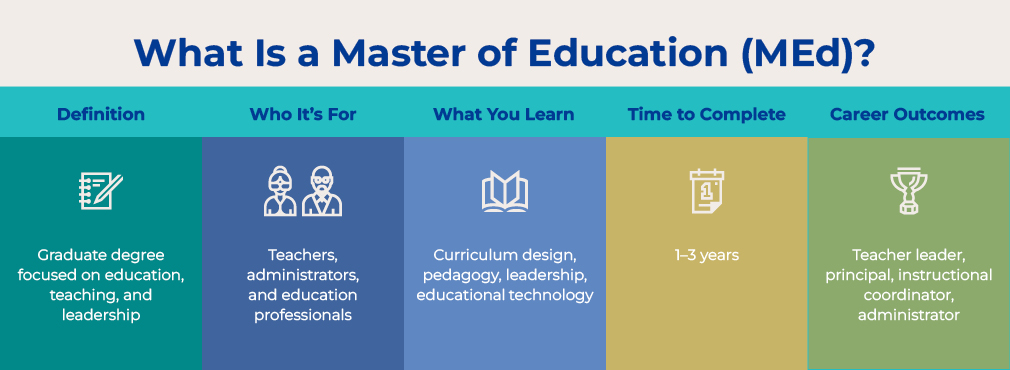
What is an MEd degree and what does it stand for?
The Master of Education (MEd) is a master’s degree program designed to prepare educators, administrators, and other professionals for complex leadership roles in the field of education, making it one of the most versatile graduate degrees in education available today. We’ll explore a few of these roles later on in this guide.
In an MEd program, students develop practical skills that can be applied in various education settings, from PK-12 schools and private universities to government organizations and policy-making bodies. For example, the MEd program at National University helps student cultivate skills like:
- Analyzing and Investigating evidence-based solutions
- Complying with industry regulations and professional codes of ethics
- Following and applying instructional design best practices
- Leading, managing, empowering, and communicating with diverse groups of educators, families, and students
Choosing a program
It’s important to choose a program that aligns with your career goals, sparks a passion for the subject matter, and targets the issues you want to address within your school district or learner community. Here are a few key factors to weigh as you evaluate potential programs:
- Accreditation Status — Look for MEd programs that have earned accreditation from national or regional organizations like WASC, which indicates that they meet rigorous quality standards and adhere to best industry practices
- Financial Aid — Research the MEd degree cost at each institution you’re considering, and compare scholarships, grants, and other funding opportunities available for MEd students, like the Opportunity Scholarship or Key Grant at National University
- Program Structure — Consider whether an on-campus program, online program, hybrid program, or accelerated degree option is the optimal fit for your schedule and learning style
Key components of an MEd program
Master of Education programs generally combine coursework with research, fieldwork, and practicum components. Let’s review some of the topics MEd students can expect to study and discuss some typical fieldwork and practicum requirements.
Core coursework
Master of Education programs structure their coursework and curriculum to help students develop a deeper, more nuanced understanding of educational theory, research, and practice. Here are a few examples of core subjects that MEd students can expect to cover:
- Courses on educational research methods, which introduce students to research methodologies, data analysis techniques, and the process of conducting and interpreting qualitative or quantitative research
- Courses on curriculum development and instructional design, where students learn how to create engaging curricula that integrate quality teaching materials, deliver measurable results, and meet state and federal standards
- Courses on diversity and inclusive education that dive into strategies for creating equitable educational environments that respect and accommodate diverse learners, cultures, and backgrounds
- Courses on educational policy and law, which teach students about compliance with the legal and legislative frameworks governing modern educational systems
Regardless of your specialization, your core courses will provide you with a robust foundation in educational theory and practice.
Practicum and field experience
For MEd students, learning continues beyond the classroom. In addition to completing regular coursework, most MEd programs require students to accumulate hands-on experience. For example, it’s common for MEd programs to integrate a practicum, a unique type of course that challenges students to put their theoretical knowledge to practical use in real educational settings, such as high schools, middle schools, and universities.
After completing supervised field work like a practicum or internship, students fulfill their remaining MEd degree requirements by completing a capstone project or thesis and, in some cases, passing state-mandated exams. Whether a student completes a capstone project vs. a thesis often depends on the MEd program’s focus, capstones emphasize applied, practice-based work, while theses involve original research, and students may also be required to pass exams like the California Basic Educational Skills Test (CBEST) or California Teacher of English Learners (CTEL) Examination, depending on their career goals.
Flexible learning options
If you’re looking for flexible study options, an online, part-time, or accelerated MEd program may be an ideal choice. These convenient options enable you to complete your degree at your own pace, on your own schedule, no matter what your calendar looks like. That means you can continue working full-time or part-time while pursuing your MEd without having to put your responsibilities or ambitions on hold.
Career opportunities with an MEd degree
Depending on which specialization you choose, a master’s degree in education can position you for a wide variety of professional roles, including PK-12 teacher, ESL instructor, special education consultant, school principal, student counselor, or instructional coordinator.
Teaching and educational leadership
An MEd program shows aspiring teachers how to implement effective instructional strategies, prepares them for leadership and directorial roles, and equips graduates for more advanced positions within schools and school districts. Professionals with an MEd may pursue careers like instructional coordinator, department chair, or curriculum specialist.
Please note: While an MEd prepares students for leadership roles, serving in certain public school leadership positions, such as principal or assistant principal, requires meeting state-specific credentialing or licensure requirements. For more information, explore the process of becoming a teacher in California, including the educational background and credentials required.
Specialized roles
Enrolling in an MEd program allows students to gain valuable expertise in specific aspects of the public and private education system, including special education, educational technology, and student counseling. Graduates of the MEd program at National University have successfully transitioned into roles as educational consultants, PK-12 and higher education counselors, and special education teachers.
Other specialist roles where MEd degrees are in demand include intervention specialist, educational diagnostician, and reading specialist or literary coach.
Administration and policy-making
MEd graduates emerge from their programs prepared to enter policy-making roles within educational organizations, government agencies, or non-profit organizations. Depending on the focus of the degree, such as a specialization in organizational leadership or higher education leadership, the MEd can also prepare you for administrative roles, such as becoming the principal or assistant principal of a high school, middle school, or elementary school.
Learn more about what you can do with a master’s degree in education.
Master of Arts vs. Master of Education
If you’re exploring graduate degrees in education, it’s important to understand the differences between a Master of Education (MEd) and a Master of Arts in Education (MAE), and later, the distinction between an MEd vs. EdD if you’re considering doctoral study.
The MEd is all about practicality, it focuses on applying educational theories and principles in real-world settings to address challenges that educators face every day. The program is geared toward developing skills you can use immediately, whether you’re a teacher looking to enhance your classroom strategies or an administrator aiming to take on leadership roles. It’s a great fit for current educators who want to grow in their careers or transition into roles like instructional coordinator or principal.
The MAE, on the other hand, focuses more on the academic side of education. This program is more research-focused, giving students the chance to explore the big-picture ideas behind education, its history, philosophy, and theory. If you’re interested in pursuing a career in academia, research, or policy-making, or even planning to go on to a doctoral program, the MAE may be a better choice.
While both degrees share some common ground, they cater to different goals.
- The MEd is designed for those actively working in education who want to sharpen their skills and take on new challenges in leadership or administration.
- The MAE is ideal for students drawn to research and theory, who might be thinking about influencing education on a broader scale or preparing for a career in academia.
Choosing the right program comes down to your career aspirations, whether you’re looking to make an immediate impact in schools or contribute to the field through research and policy.

Earn your Master of Education degree online at National University
Whether your goal is to inspire the next generation of students, lead an underperforming school district to success, provide consulting services to educators, or explore other corners of the education industry, an MEd degree is a powerful asset that shows your commitment and expertise.
With fast-paced eight-week courses, evening and weekend classes, and options to complete your studies online or on-campus, National University offers convenience and flexibility while challenging students to excel and grow. Learn more about graduate admissions process or start your application to National University.

This content has been reviewed and approved by the National University Editorial Advisory Board. Learn more about our editorial process.


