
If you’re passionate about working with individuals with autism and other neurodiverse needs, you’ve likely considered learning how to become a Board-Certified Behavior Analyst®. BCBAs perform an invaluable service, often providing the specialized care and intervention planning to ensure patients’ long-term success. For graduates of programs like the Master of Science in Applied Behavior Analysis (ABA) at National University (NU), certification is essential to working at the highest levels of the field.
BCBA Certification Steps
Assuming you have or are in the process of getting your MSABA degree, you’re probably wondering how to become a BCBA. In addition to your graduate courses, you’ll have to complete 2,000 hours of supervised fieldwork or 1,500 hours of concentrated fieldwork. This provides aspiring BCBAs the additional time, skills, and mentorship necessary to succeed on test day.
When it’s time to apply to take the exam, graduates must show proof of their qualifying degree and fieldwork to the Behavior Analyst Certification Board (BACB). The final step: passing the 185-question exam, which covers the fundamentals of behavior analysis and its myriad real-world applications.
But let’s not get ahead of ourselves. This blog will guide prospective students through the key steps needed to become a BCBA.
Key Takeaways
- Becoming a BCBA requires a master’s degree in ABA or a related field
- Students must complete supervised (or concentrated) fieldwork hours approved by the BACB.
- Selecting a program that satisfies 2027 BACB eligibility pathways is extremely important. This can be accomplished with a master’s degree accredited by the Association for Behavior Analysts International (ABAI) or the Association of Professional Behavior Analysts (APBA), or by selecting a program that offers a registered Faculty Coursework Attestation (Pathway 2).
- Passing the BCBA certification exam is the final step.
What is a Board Certified Behavior Analyst (BCBA)?
Put simply: the Board Certified Behavior Analyst® (BCBA®) certification is a graduate-level credential in behavior analysis awarded by the Behavior Analyst Certification Board (BACB). It ensures that professionals are adequately prepared to provide behavior-analytic support to clients across a wide range of industries. Indeed, while many board-certified behavior analyst roles involve working with individuals with autism or other forms of neurodiversity, BCBAs enjoy access to a number of potential career paths.
Common settings for BCBAs include:
- Schools: Here, BCBAs act as consultants, advising teachers and leadership on behavioral strategies at both the micro and macro levels.
- Clinics: In this context, BCBAs direct assessments, manage caseloads, and oversee intervention planning for clients with advanced needs.
- Healthcare and Community Agencies: BCBAs apply specialized analysis to improve behavioral outcomes for a variety of clients in the public and private sectors.
Step 1: Earn a Master’s Degree in Applied Behavior Analysis
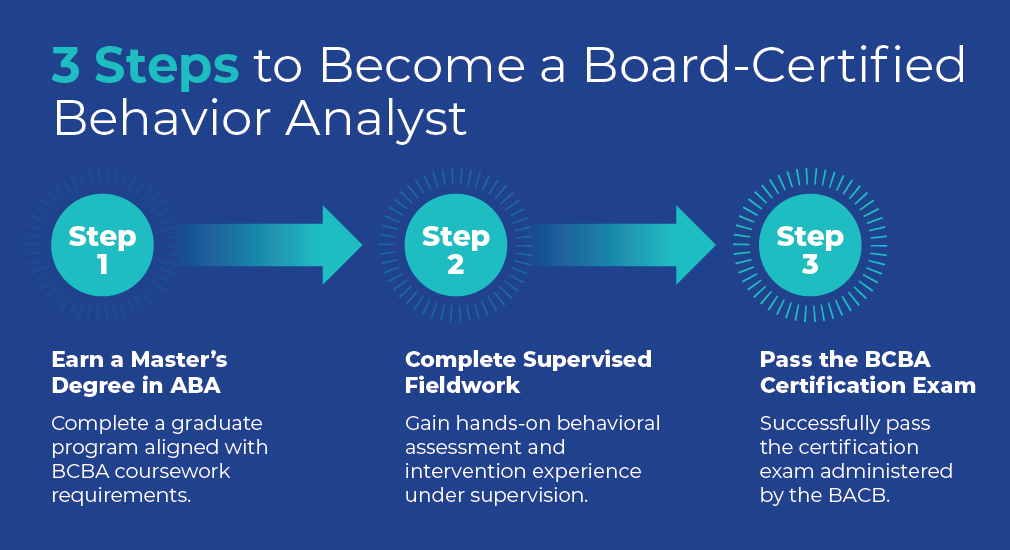
As you’ve surely noticed by now, BCBA certification necessitates proof of a qualifying degree. While it’s not uncommon for graduates with a master’s in psychology or education to pursue a BCBA credential, many candidates bring a master’s in ABA with them on test day. Regardless, it’s crucial you select a program that meets the BACB’s 2027 coursework verification standards. National University’s MS in ABA is specifically tailored to satisfy these requirements, giving you the confidence you’ll need to pass the certification exam and start helping those with behavioral challenges.
Step 2: Complete Supervised Fieldwork
BCBA supervised fieldwork is an integral part of certification. It provides the time and mentorship — 2,000 hours of supervised fieldwork or 1,500 hours of concentrated fieldwork — to gain practical, hands-on experience under the counsel of a qualified supervisor. During your ABA clinical training, you’ll work directly with real patients to administer behavioral assessments and implement intervention plans. You’ll also design data collection systems and evaluate their effectiveness. Keep in mind: since you’ll receive regular feedback regarding these responsibilities, the nature of your relationship with your supervisor is critical to your success.
Step 3: Pass the BCBA Certification Exam
Remember, to become a BCBA, you’ll have to pass a certification exam administered by the BACB. You’ll have four hours to answer 185 multiple-choice questions covering behavior assessment, intervention design, data interpretation, and acceptable ethical and professional conduct. While this may sound overwhelming, your extensive coursework and supervised fieldwork are designed to prepare you for precisely this moment. And NU’s commitment to providing a Whole Human Education™ means you’ll have 24/7 access to the academic support you’ll need to perform at your best. Our holistic approach ensures that you aren’t just prepared for the BCBA exam, but for your future career as a certified professional.
Why Clinical Experience Matters in ABA Training
Your ABA clinical training will go a long way toward shaping your career as a certified professional. There is simply no substitute for applied behavior analysis experience, as it strengthens your understanding of the very behavioral interventions you’ve studied for years. Working under the guidance of a supervisor offers a productive structure to apply your skills and knowledge to the care of real individuals with complex needs.
Whether you’re conducting a risk-benefit analysis, developing a discharge plan for fading services, or carrying out any one of a number of other behavior-analytic tasks, your supervisor is there to help you succeed. Because you’ll be working so closely with this mentor, it’s important that you choose someone with expertise in your focused area(s) of study. Effective supervisors tend to be organized, communicative, and thoughtful about their training.
It always helps to be clear-eyed about the responsibilities and expectations of any working relationship, and your association with your supervisor is no different. A quality training environment gives you the opportunity to bolster your behavior analysis skills in meaningful ways. Their guidance serves as the bridge between your ABA background and its real-world application.

How National University’s MS in ABA Supports BCBA Preparation
NU’s program is aligned with 2027 BACB standards, ensuring that students fulfill the required content hours through a verified pathway. With its emphasis on ethical practice, applied learning, and supervised fieldwork preparation, graduates are well-equipped for the rigorous demands of the BCBA exam. Most importantly, National University’s ABA program offers the support, and flexibility students need to stay on track, finish faster, and achieve their goals.
Career Paths for Board Certified Behavior Analysts
The good news for ABA graduates is that there’s no shortage of behavior analyst career paths available. In fact, the Bureau of Labor Statistics (BLS) forecasts a 17% growth rate over the coming decade. Demand now outpaces supply, driven largely by ABA-related insurance changes and the rising prevalence of autism spectrum disorder (ASD) diagnoses. Particularly salient for graduates planning to get credentialed: between 2024 and 2025 alone, a BACB analysis found a 28% increase in the number of job listings requesting BCBA certification.
Perhaps more important than any figure or projection is the fact that BCBAs perform meaningful work across a wide variety of contexts and industries. You’ll most commonly find professionals in BCBA careers within autism support programs, behavioral health clinics, and special education systems. They’re also a vital asset to healthcare and community organizations. No matter the environment, BCBAs play a critical role in improving behavioral outcomes for countless clients each year.
Tips for Choosing the Right ABA Graduate Program
Finding the right ABA graduate program is no walk in the park, but by focusing on a few key considerations, you can make the process infinitely less stressful and time-consuming.
A brief list of ABA program selection tips:
- Confirm Coursework Verification: Ensure your program adheres to 2027 standards, either via programmatic accreditation or a faculty member who can provide coursework attestation to the BACB.
- Evaluate Fieldwork Opportunities: Remember to take your time with this step, as your relationship with your supervisor is arguably the most important you’ll form during training.
- Verify Accessibility and Flexibility: If you’re a working professional, make sure to consider the accessibility and flexibility of whichever ABA program you end up selecting.
- Review Faculty Expertise: Carefully examine every program’s faculty background and its emphasis on clinical training.
Lastly, see what you can learn about a program’s reputation for exam pass rates. To enjoy a successful career in behavior analysis, it’s imperative that you partner with a university that provides robust academic support and reflects your professional aspirations.
Frequently Asked Questions
Most BCBAs have a master’s in ABA, but it’s not uncommon for graduates with backgrounds in psychology, education, and behavior science to pursue BCBA certification.
Big picture: 6-8 years, including those you’ll spend getting a bachelor’s degree. Most graduate ABA programs run 1.5-2 years (NU’s can be completed in eighteen months), during which time you’ll also perform supervised fieldwork. After that it’s simply a matter of studying up and waiting for your exam application to be processed.
The VCS system was officially retired on January 1, 2027. The BACB now verifies coursework through two different pathways. The first is for students who graduate from a program accredited by ABAI or APBA, while the second is for those in non-accredited programs. In the latter scenario, a designated faculty member must provide an official coursework attestation to the BACB. National University has a designated Pathway 2 Contact, who send the coursework attestation form directly to the BACB.
BCBAs are professionals devoted to improving behavior-related challenges for a wide variety of clients. In contexts spanning education, healthcare, and community organizations, BCBAs analyze data, conduct behavioral assessments, and design and implement intervention plans.
Conclusion
Tasked with improving complex behavioral challenges in a number of different contexts, BCBAs provide meaningful support to every client they work with. It’s a deeply rewarding profession that gives practitioners the chance to make a lasting impact on a varied set of stakeholders. Regardless of your ultimate career goals, National University’s Master of Science in Applied Behavioral Analysis is designed to provide the support and flexibility you need to achieve them as efficiently as possible.

This content has been reviewed and approved by the National University Editorial Advisory Board. Learn more about our editorial process.


