
Does working with complex equations fire you up? Are you as comfortable writing code as you are inspecting circuits? If you grew up taking things apart just to discover how they worked, you’re already thinking like an engineer. This article will help you determine whether that lifelong curiosity might translate to a rewarding career through a degree in Electrical and Computer Engineering (ECE) from National University (NU).

Software and Circuitry: A Match Made in Heaven
You’d be hard-pressed to find a form of modern technology that wasn’t configured or improved by the hybrid field of electrical and computer engineering. Everything from the smartphone in your pocket to the electrical grid powering your home was in some way touched by the complex interplay of software and circuitry.
As automation continues to fuel rapid, structural changes to the global economy, it has never been more important to understand the hardware, systems, and embedded tech that make our interconnected world possible. With a comprehensive curriculum covering advanced mathematics and programming concepts to microelectronics and circuit analysis, the ECE degree at NU is tailored to provide students with the theoretical foundation and technical expertise necessary to shape the future of innovation.
Key Takeaways
- ECE is a hybrid field. It merges circuits and hardware design (electrical engineering) with software-hardware integration (computer engineering).
- The ECE major rewards those with a growth mindset. NU’s ECE program is geared toward students who enjoy logic, systems, and solving real-world tech problems.
- Strong career outlook: This hybrid skill set is expected to be in demand as roles in hardware engineering, IoT development, and embedded systems integration keep growing.
What Electrical and Computer Engineering Really Is
When it comes to our current technological landscape, we can think of electrical engineering (EE) as specializing in circuits and hardware design, and mechanical engineering (ME) in the creation of physical, power-generating machinery. Computer engineering (CE), by contrast, focuses on the integration of hardware and code. ECE is where these disciplines converge to create the increasingly intelligent systems we engage with today.
Think of it this way: you wouldn’t have the laptop you’re reading this on without the microcircuits designed by highly skilled electrical engineers, nor would you be able to so easily learn more about how NU’s ECE program is accredited by the Engineering Accreditation Commission of ABET without the signal processing and communication systems that make the entire internet possible. From EVs and satellites to fitness watches and home security systems, we’re constantly surrounded by a seemingly infinite number of relationships between hardware and software. This interconnectedness is precisely what makes an ECE background so relevant and worthwhile in today’s marketplace.
Signs You Might Thrive in Electrical and Computer Engineering
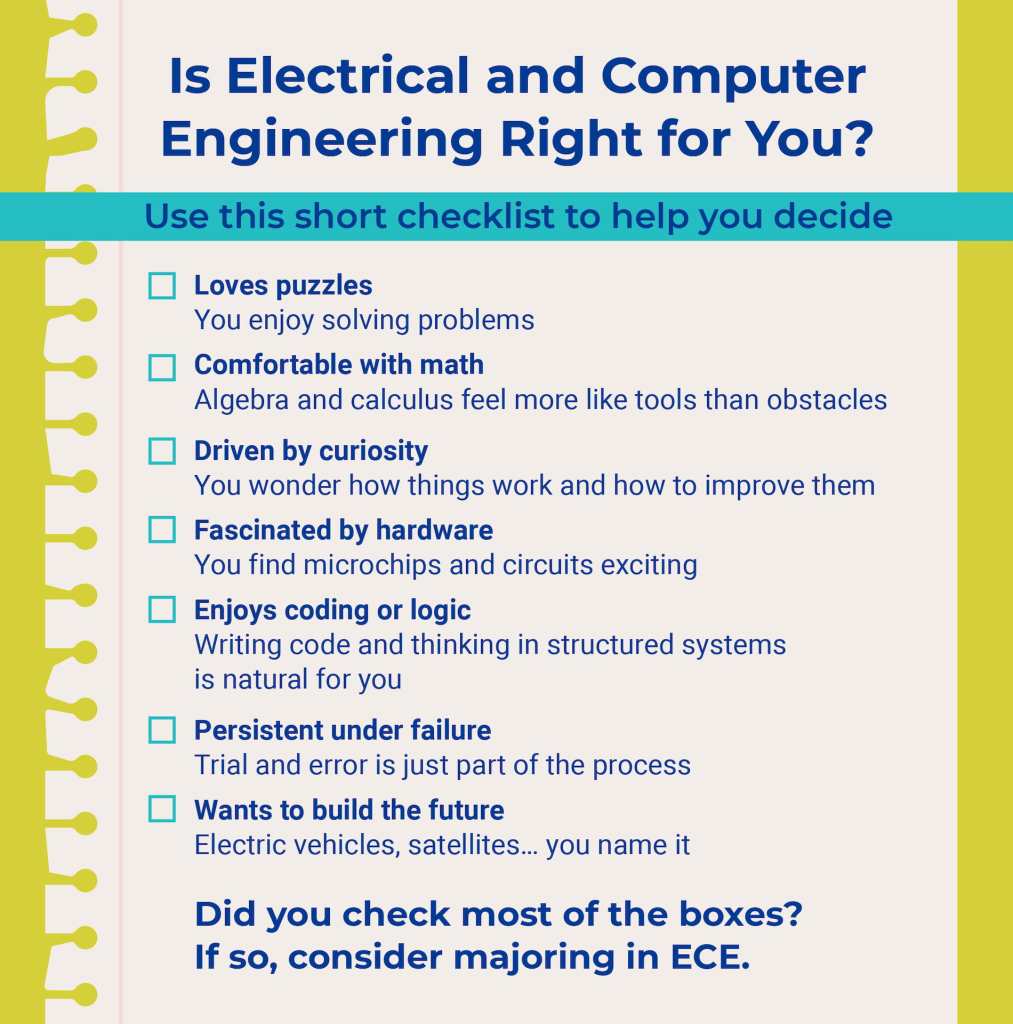
But is ECE right for me? Well, ECE is for the tinkerer, the puzzle solver. It’s for anyone who enjoys complex, structured problems, who marvels at the magic of microchips and space travel and yearns to contribute to future breakthroughs of similar magnitude. If you’re comfortable with math, logic, and abstract thinking — if you ever wonder not just how a gadget works, but how you might make it faster, smaller, or easier to use — you’ve got the engineering mindset necessary to succeed in the field.
Strengths that Help Students Succeed in ECE
If you’re still on the fence about pursuing a career in ECE, it’s worth considering the strengths that best position students for future success. The ability to think analytically, for example, is absolutely essential, as is an intense attention to detail. Because ECE is defined by trial-and-error and frequent bouts of debugging, a creative mindset and a healthy dose of persistence are invaluable. In the end, ECE success skills boil down to having the aptitude to learn highly complicated concepts and the patience to master them step-by-step.
What You’ll Learn in a Degree in ECE
NU’s ECE degree is as rigorous as it is thorough, featuring courses on Microelectronics, Circuit Analysis, and Computer Architecture. Among other core ECE principles, NU students will gain a deep familiarity with logic and electronics fundamentals, the marriage between design and integration, and programming for hardware and embedded systems. Perhaps most importantly, our curriculum has been specifically tailored to help future professionals apply theory and mathematics to the solution of practical, real-world problems.
What Kind of Problems Do Electrical and Computer Engineers Solve?
Remember that earlier bit about how ECE attracts puzzle-solvers? Well, in this case, the puzzles look less like something you spend all winter assembling atop an otherwise neglected coffee table and more like the design and implementation of embedded systems in everyday devices. Additional ECE applications range from engineering the hardware that powers cloud computing to architecting the streamlined delivery systems used in transportation and health care. From the rapid adoption of robotics and AI to advancements in wireless communications and renewable energy infrastructure, electrical and computer engineers are working on the most vexing challenges of our time.
Career Paths for ECE Graduates
The engineering jobs outlook in 2026 remains as promising as ever. And since our ECE program deftly bridges the gap between hardware and software, NU graduates enter the workforce with a multifaceted toolkit readily adaptable to nearly every kind of engineering role. While individual outcomes largely depend on specialization, internships, and project work, graduates often find themselves in high-demand career paths like hardware engineering, IoT development, and embedded systems integration. Regardless of which route you choose, it’s worth familiarizing yourself with the Career Outlook section of our ECE page, where you can find information regarding median salaries and the number of job openings posted in the last year.

Job Outlook and Long-Term Value of an ECE Degree
An especially notable and encouraging aspect of pursuing an ECE degree? ECE career prospects appear to be about as future-proof as one could possibly hope for in today’s economy, with salaries that reward the rigor and expertise necessary to succeed in the field. The demand for ever more powerful computing and hardware development continues unabated, and automation tools (heard of AI?) will only become more ubiquitous moving forward. Whether you specialize in infrastructure modernization, network communications systems, or a different branch of ECE altogether, there’s a role for you, and NU is here to help.
Common Challenges Students Face (And How to Prepare)
As should be evident by now, the field of ECE is no walk in the park. Curricula are not only highly complex but also reliably demanding, with theoretical foundations heavily rooted in advanced math and extensive lab work required. Candidates should expect to encounter a steep learning curve (this is where persistence comes in!), and will need to devise time management strategies to improve their chances of success. The tried-and-true engineering success tips all apply here: study often and seek institutional support and guidance whenever possible. And remember: you can do this!
Why Program Format Matters for Today’s Engineering Students
Chances are you’ve come to this page with a number of life responsibilities you can’t simply ignore, no matter how interested you may be in ECE. Don’t worry: NU’s flexible engineering degree offers the structure and support to help you graduate as efficiently as possible. Our program format is designed to accommodate busy learners, working professionals, and military-affiliated students. Just as importantly, we’ve created an academic structure that emphasizes consistency, accessibility, and hands-on learning opportunities for every NU student.
How National University Supports Engineering Students
NU’s ECE program is an ideal fit for working adults, offering a career-relevant curriculum, accessible instruction, and readily available institutional support. Our focus is on ensuring students achieve desired professional outcomes at a pace that works for them, and we’re committed to providing the flexibility and assistance to keep them thriving both in and out of the classroom. If you’re interested in pursuing NU’s ECE degree, rest assured you’ll receive a Whole Human Education™ in the process, one that breaks down any barrier keeping you from the future you’ve always wanted.

Frequently Asked Questions
Put simply: ECE is an interdisciplinary field that blends coursework in electronics and circuitry with hardware design and software development. It spans everything from microchips and circuit boards to the distribution of energy systems and advancements in global communication networks.
Very much so. As the global economy continues to adopt AI and other forms of automation at a dizzying pace, the demand for professionals who understand the physical nature of technology will only grow.
In short: ECE is a versatile degree that positions graduates for higher salaries and rewarding careers, regardless of which particular path they choose to pursue.
At its simplest, EE focuses more on the physical world — things like sensors, circuitry, power generation, etc — whereas CE is interested in the integration of hardware and software via microprocessors and computer architecture.
In many ways, the engineering jobs outlook has never looked better. Common career paths include hardware engineer, IoT developer, embedded systems engineer, and renewable energy specialist, among many others.
Whether one path is “harder” than the other is obviously subjective, but it’s worth remembering that ECE and computer science (CS) test different parts of the brain. With its emphasis on various programming languages, advanced logic, and data systems, CS is undeniably abstract. ECE, by contrast, is rooted in both theory and its real-world applications, making it a uniquely rigorous and well-rounded degree. After all, ECE students aren’t just concerned about why their software fix just glitched; they’re also wondering why yet another circuit is overheating.
Shape the Future of Innovation at National University
For over 50 years, our mission has been to provide accessible, achievable higher education to adult learners. If you’re ready to build the tools of tomorrow in a flexible and supportive environment, explore NU’s ECE program today.


