
The hiring market in 2026 faces a defining paradox: applications per job opening have doubled since 2022, yet employers report unprecedented difficulty filling positions. Nearly 70% have shifted to skills-based hiring, recognizing that credentials no longer predict job readiness. National University examined 67 critical hiring statistics that reveal what both employers and job seekers must do to succeed.
How Is Skills-Based Hiring Reshaping the Job Market?
Skills-based hiring is rapidly transforming how employers evaluate candidates, with nearly 70% of organizations now prioritizing skills over traditional degree requirements. This shift creates significant opportunities for adult learners with demonstrated competencies and professional certifications, even if they followed non-traditional educational paths.
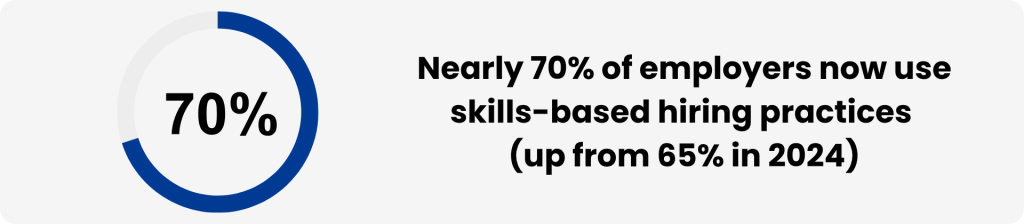
- Nearly 70% of employers now use skills-based hiring practices (up from 65% in 2024).
- Skills-based hiring can expand talent pools by 15.9× in the U.S. and 6.1× globally.
- 86% of employers view non-degree certifications as important indicators of job readiness.
- Skills-based organizations have 98% higher retention of high performers.
- Only 46% of employers plan to expand skills-based hiring in 2026 due to verification challenges.
- 53% of employers cite verifying skill claims as their main obstacle.
- 39% of workers’ core skills are expected to change by 2030.
- In Financial Services, skills-based hiring could expand candidate pools by 12×.
- Referred workers are 25% more profitable than non-referred workers.
What Hiring Challenges Are Employers Facing in 2026?
Employers report unprecedented difficulty finding candidates with the right skills and experience, even as application volumes surge. This talent shortage creates opportunities for candidates who invest in upskilling and can demonstrate job-ready competencies.
- 69% of employers are struggling to find qualified candidates for open positions.
- 46% of employers say attracting qualified candidates is their #1 challenge.
- 36% of companies have open positions they cannot fill, with skills being the primary obstacle.
- 50% of employers cite lack of relevant experience as the primary hiring obstacle (not pay).
- Hiring grew 8.3% year-over-year but remains 30% below 2021 levels.
- 52% of employees are open to leaving their current role in 2026.
- Applications per job opening have doubled since spring 2022, with applications per hire increasing 182% from 2021 to 2024.
- 91% of employers anticipate obstacles in 2026, with skill gaps topping concerns.
- A 40% skills gap by 2027 is projected by the World Economic Forum.
- 63% of employers view skill shortages as the top barrier to transformation.

How Much Do Employers Spend, and How Long Does Hiring Take?
Hiring is both expensive and time-consuming, especially for specialized roles. Understanding these metrics helps candidates appreciate why employers are selective and why demonstrating value quickly matters.
- Average cost per hire is approximately $4,700 (SHRM benchmark for 2026).
- Software engineer hiring costs range from $8,000 to $20,000.
- Executive hires cost between $25,000 and $50,000 or more.
- National average time to fill ranges between 63-68 days as of January 2026, varying significantly by industry and company size.
- Time from application to initial screening improved to 7.2 days (from 8.3 days in 2024).
- Only 0.5% of applicants are ultimately hired, showing extreme selectivity.
- Offer acceptance rates reached 82% in 2026, the highest since 2021.
- 31% of candidates decline job offers, often citing poor communication as the top reason.
- Candidates are 66% more likely to decline offers than before the pandemic.
- The average time to fill a tech position is 52 days.
Why Do Employee Referrals Perform So Well?
Employee referrals consistently outperform all other hiring sources in quality, speed, and retention. For job seekers, this underscores the critical importance of professional networking and building authentic workplace relationships.
- 82% of employers utilize employee referrals as a primary candidate source.
- 88% of employers consider referrals the most effective recruitment source.
- Referrals make up only 7% of applications but account for 30–50% of all hires.
- Referral candidates are 4x more likely to get hired than other applicants.
- Referred hires have a 46% retention rate vs. 33% for job board hires.
- It takes 29 days to hire a referral vs. 39 days for other sources.
- Employers save approximately $3,000 per referral hire.
- Referral hires show a 33% increase in job performance.
- Job boards produce 61% of applications but only 42% of hires.
- Company career pages generate 13% of applicants but 26% of hires.
How Are AI and Technology Changing Recruiting?
AI and automation are now embedded throughout the hiring process, from sourcing to screening to communication. Both employers and candidates are leveraging AI tools, making technological literacy an essential part of modern job search strategy.
- 67% of companies plan to increase investment in AI and automation tools for recruitment in 2026.
- 79% of job seekers now use AI tools in their applications.
- 66% of hiring managers use AI-detection software to screen resumes.
- 84% of organizations use social media for recruitment.
What Does the Interview and Candidate Experience Look Like Now?
Hiring processes are longer and more rigorous than ever, while candidates increasingly expect respectful, transparent communication. This section reveals why professionalism and follow-through matter for both employers and job seekers.
- Interviews per hire are up 33% overall, reflecting increased selectivity.
- Technical roles average 35–36 interviews and 26 interviewer hours per hire.
- Recruiters handle 93% more applications and manage 40% more open roles than in 2021.
- Recruiting teams are 14% smaller than in 2021, yet workload increased dramatically.
- Hires per recruiter have dropped 43% since 2021.
- 66% of candidates say they accepted an offer due to an exceptional recruitment experience.
- 61% of job seekers report being ghosted after an interview, up 9 percentage points in 2024.
- Only 26% of job seekers report having a great candidate experience.
- 72% of candidates expect the recruitment process to take three weeks or less.
- 42% of candidates say negative interview experiences led them to decline offers.
- 95% of employers conduct employment background screening during the hiring process.

How Do Diversity, Flexibility, and Gen Z Expectations Influence Hiring?
Job seekers, especially younger professionals, are prioritizing diversity, workplace flexibility, and purpose alongside compensation. Organizations that adapt to these evolving expectations have a competitive advantage in attracting top talent.
- 76% of job seekers consider a diverse workforce important when evaluating job offers.
- Nearly one-third of candidates will not apply to companies they perceive as lacking diversity.
- Companies in the top quartile for diversity are 35% more likely to achieve better financial returns.
- Resumes with white-sounding names receive about 50% more callbacks than those with Black-sounding names.
- Remote jobs now make up approximately 15% of total U.S. opportunities, up from 4% pre-pandemic.
- 85% of workers say remote work is the #1 factor they consider in job applications, ahead of competitive pay.
- 76% of workers would look for a new job if remote work were eliminated.
- 71% of Gen Z workers prefer a hybrid workplace model.
- 70% of Gen Z employees expect a promotion within their first 18 months on the job.
How Do Onboarding and Early Experiences Affect Retention?
The first weeks and months in a new role are critical for long-term engagement and retention. Strong onboarding and consistent early support can dramatically improve outcomes for both employers and new hires.
- Up to 20% of staff turnover happens within the first 45 days of employment.
- 70% of new employees decide if a job is the right fit within their first month, and 29% decide within the first week.
- 69% of employees are more likely to stay at least three years after a great onboarding experience.
- Strong onboarding processes can improve new hire retention by 82%.
Sources
Skills-Based Hiring & Market Trends:
- Forbes. “Why Only 46% Of Employers Plan To Expand Skills-Based Hiring In 2026.” https://www.forbes.com/sites/carolinecastrillon/2025/12/15/why-only-46-of-employers-plan-to-expand-skills-based-hiring-in-2026/
- iMocha. “Top 50 Skills-Based Hiring Trends and Statistics for 2026.” https://www.imocha.io/blog/skills-based-hiring-trends
- NACE. “Employer Use of Skills-Based Hiring Practices Grows.” https://www.naceweb.org/job-market/trends-and-predictions/employer-use-of-skills-based-hiring-practices-grows
- Yupro Placement. “From Headcount to Skill Count: The New Workforce Playbook for 2026.” https://yupro.com/blogs/from-headcount-to-skillcount/
Hiring Challenges & Talent Shortage:
- Kelly Services. “Top 8 Hiring Challenges of 2026.” https://www.kellyservices.us/news-and-insights/top-hiring-challenges-2026
- Skima AI. “Top 60+ Recruitment Statistics to Enhance Hiring in 2026.” https://skima.ai/blog/industry-trends-and-insights/recruitment-statistics
- Trucking Dive. “2026 hiring outlook improves, but skills and AI are primary hurdles.” https://www.truckingdive.com/news/2026-hiring-outlook-improves-skills-ai-hurdles/809059/
Recruitment Metrics & Costs:
- Employ Inc. “2026 Hiring Benchmarks: How You Stack Up.” https://www.employinc.com/blog/2026-hiring-benchmarks-does-your-recruiting-stack-up/
- FMC Group. “Average Cost Per Employee: 150+ Global Stats .” https://fmcgroup.com/average-cost-per-employee/
- TimeClick. “The Real Cost of Hiring an Employee in 2026.” https://timeclick.com/cost-of-hiring-an-employee/
Employee Referrals:
- Columbia Business School. “The Value of Hiring through Referrals.” https://business.columbia.edu/sites/default/files-efs/pubfiles/25926/Hiring_Referrals.pdf
- Boon. “Referral Hiring: The Solution to High Turnover Rates?” https://www.goboon.co/post/referral-hiring-the-solution-to-high-turnover-rates
- Staffing Hub. “Company Pages, Referrals Result in More Hires: Recruiting Metrics Report.” https://staffinghub.com/hiring/company-pages-referrals-result-in-more-hires-recruiting-metrics-report/
AI & Technology in Recruiting:
- Kelly Services. “Top 8 Hiring Challenges of 2026 (And How Your Organization Can Overcome Them). https://www.kellyservices.us/news-and-insights/top-hiring-challenges-2026
- Skima AI. “Top 60+ Recruitment Statistics to Enhance Hiring in 2026.” https://skima.ai/blog/industry-trends-and-insights/recruitment-statistics
Candidate Experience:
- ClearOffer. “Why 31% of Candidates Decline Your Offer (And What’s Your Plan?).” https://clearoffer.io/blog/05_why-candidates-decline/
- JobScore. “Candidate Experience Statistics You Must Know in 2026.” https://www.jobscore.com/articles/candidate-experience-statistics/
- Senseloaf. “Candidate Experience in Recruitment: Key Insights, Trends, and Best Practices.” https://www.senseloaf.ai/blog-articles/candidate-experience-in-recruitment-stats-trends-best-practices
- Talent MSH. “Candidate Experience Statistics, Data, & Trends.” https://www.talentmsh.com/insights/candidate-experience-statistics
Diversity & Workplace Trends:
- Cake Resume. “The Gen Z Effect and the Workforce Evolution: 2025 Statistics.” https://cake.com/blog/gen-z-workforce-statistics/
- FlexJobs. “Remote Work Index: Trends & Statistics (2026).” https://www.flexjobs.com/blog/post/flexjobs-remote-work-economy-index
- Joveo. “The Ultimate Guide to Diversity Hiring .” https://www.joveo.com/the-ultimate-guide-to-diversity-hiring/
- NovoResume. “65 Workplace Diversity Statistics You Need to Know in 2026.” https://novoresume.com/career-blog/workplace-diversity-statistics
- Poverty Action Lab. “Discrimination in the Job Market in the United States.” https://www.povertyactionlab.org/evaluation/discrimination-job-market-united-states
- Robert Half. “Remote Work Statistics and Trends for 2025.” https://www.roberthalf.com/us/en/insights/research/remote-work-statistics-and-trends
- StrongDM. “11 Surprising Statistics on Remote Work for 2026.” https://www.strongdm.com/blog/remote-work-statistics
Onboarding & Retention:
- HiBob. “Onboarding statistics and trends in 2026.” https://www.hibob.com/blog/onboarding-statistics/
- HireSafe. “How Employment Background Checks Improve Hiring.” https://www.hiresafe.com/how-employment-background-checks-improve-hiring/
- Select Software Reviews. “20+ Essential Employee Retention Statistics for 2026.” https://www.selectsoftwarereviews.com/blog/employee-retention-statistics
- StrongDM. “25 Surprising Employee Onboarding Statistics in 2026.” https://www.strongdm.com/blog/employee-onboarding-statistics
- Thirst. “22 Employee Onboarding Statistics for 2026 Every L&D Leader Should Know.” https://thirst.io/blog/22-employee-onboarding-statistics-for-2026-every-ld-leader-should-know/

This content has been reviewed and approved by the National University Editorial Advisory Board. Learn more about our editorial process.


