
Associate of Arts in General Education
Online, In-Person & Hybrid
Flexible options
250K+ Alumni Worldwide
Become a member of NU’s global community
Year-round enrollment
Our admissions team reviews applications year round.

Take the first step in your National University Journey

Earn a General Education Degree and Expand Your Knowledge and Opportunities
Degree:
Associate of Arts in General Education
Application:
$0 application fee. No essays/exams.
A well-rounded education is vital for living a more rewarding life, and in preparing you for further study in a major field of specialization. National University’s Associate of Arts in General Education program provides the building blocks for your intellectual growth with instruction on English and mathematical skills, as well as the humanities, information literacy, science, and social science disciplines.
Your general education curriculum will begin with a focus on writing and speech, then expand to develop your abstract reasoning capabilities through courses in mathematics and informational literacy. Finally, you’ll explore the natural sciences, humanities, fine arts, language, and the social and behavioral sciences. Throughout many of these courses, the instruction will include an examination of the human condition in a multicultural society.
Pursuing an associate of arts in general education is an opportunity for discovery and self-improvement on its own, but it also serves as an introduction to and foundation for areas of study you may want to explore further. It prepares you for a more insightful, rewarding life, whether you aspire to additional education or not.
Why National University’s Online General Education Program?
- Hands-On Learning in the Essentials of Education. With new writing and speech skills and a better understanding of mathematics, the sciences, and multicultural environments, you’ll have a firm foundation for communicating, learning, and decision-making in all aspects of life and work.
- Designed for Working Professionals. Our program offers asynchronous and online course formats that fit the busy schedules of adult learners with convenient four-week courses, monthly starts, and year-round enrollment.
- Tools for Life and More Advanced Studies. The focus on communication fundamentals combined with a broad range of math, science, humanities, and cultural subjects prepares you for a lifetime of personal growth, self-development, and greater possibilities for further education.
Degree Requirements
To receive the AA degree in General Education, students must complete at least 60 semester credit hours, 12 of which must be taken in residence at National University. Of the 60 semester credit hours required, 46 must fall into the areas of General Education as listed below. A list of courses for each category can be found in the General Education section of the Catalog under General Education for Bachelor Degrees. In the absence of transfer credit, additional general elective courses may be taken to fulfill the total unit requirement for the degree.
The General Education Program consists of a minimum of 46 semester credit hours. Of the 46 semester credit hours, students must complete at least 3.0 semester credit hours at the upper-division level and 3.0 semester credit hours in diversity enriched coursework. A plus [+] indicates a diversity enriched offering.
Students are urged to meet English and mathematics requirements as early as possible in their college studies to avoid serious difficulties in other coursework. Refer to the section on Undergraduate Admission Procedures for specific information regarding application and placement evaluation.
Effective College English
3.0 Semester Credit Hours
An introductory course on the written academic discourse patterns required for college-level writing. Emphasizing essay-length compositions, the course covers critical reading, thesis formation, essay organization, and basic revision techniques.
Public Speaking
3.0 Semester Credit Hours
Introduction to the principles and application of speaking effectively to diverse audiences in specific contexts. Focus is on topic selection, organization, analysis of research, constructive feedback, and content delivery, with special attention to learning effective content delivery skills.
Intro to Interpersonal Comm
3.0 Semester Credit Hours
An introduction to the principals and application behind effective interpersonal communication. Students will study various styles of interpersonal communication, apply different techniques, and evaluate their effectiveness. Important components of interpersonal communication that include listening, conflict management, and developing and maintaining relationships, will be addressed in the personal and professional setting.
Mathematics Non-STEM Majors
3.0 Semester Credit Hours
Prerequisite: MTH 12A and MTH 12B or equivalent or Accuplacer test placement into College Level Math
Designed to provide non-STEM majors with a comprehensive review of fundamental mathematics principles essential for academic success and real-world applications. Students explore key algebra, statistics, and probability concepts, building a strong foundation in problem-solving and analytical thinking. Emphasizing real-life applications, course also demonstrates how mathematical reasoning is used in decision-making across various fields, including social sciences, business, and the arts.
Fundamentals of Mathematics I
3.0 Semester Credit Hours
Prerequisite: MTH 12A and MTH 12B
A study of the real number system and its subsystems, ancient and modern numeration systems, problem-solving and simple number theory. Includes teaching materials and discussion of today’s professional organizations. This is a content course, not a methods course.
Probability and Statistics
3.0 Semester Credit Hours
Prerequisite: MTH 12A and MTH 12B or Accuplacer test placement evaluation
An introduction to statistics and probability theory. Covers simple probability distributions, conditional probability (Bayes Rule), independence, expected value, binomial distributions, the Central Limit Theorem, hypothesis testing. Assignments may utilize the MiniTab software, or text-accompanying course-ware. Calculator with statistical functions is required.
College Algebra & Trigonometry
3.0 Semester Credit Hours
Prerequisite: MTH 12A and MTH 12B or Accuplacer test placement evaluation
Examines higher degree polynomials, rational, exponential and logarithmic functions, Trigonometry and matrix Algebra. Completion of this course prepares a student to take Calculus and other upper level Math courses. This course is specifically for mathematics, computer science, and engineering majors.
Calculus I
3.0 Semester Credit Hours
Prerequisite: MTH 215 or Accuplacer test placement
(Cross listed and equivalent to CSC208) An introduction to limits and continuity. It examines differentiation and integration concepts with applications to related rates, curve sketching, engineering optimization problems, and business applications. Students may not receive credit for both MTH220 and CSC208.
Calculus II
3.0 Semester Credit Hours
Prerequisite: SEL 6000
A discussion of differentiation and integration concepts of the natural logarithm, exponential and inverse trigonometric functions and applications to volumes of revolution, work and arc length. Covers improper integrals and highlights ideas and contributions of Natpier, Huygens and Pascal. Graphing calculator is required.
Fundamentals of Mathematics II
3.0 Semester Credit Hours
Prerequisite: MTH 209A
This continuation of MTH 209A includes concepts of measurement, geometry, probability and statistics, elementary synthetic and Euclidean Geometry. Methods are incorporated whenever possible. However, both MTH 209A and MTH 301 are content/concept courses as prescribed by State regulations, not methods courses. Calculator may be required.
Calculus for Comp. Science I
3.0 Semester Credit Hours
Prerequisite: MTH 215
(Cross-listed and equivalent to MTH220) Focus on differential and integral calculus with applications. Topics include limits and continuity, derivatives, standard rules of differentiation including chain rule, exponential and logarithmic forms, curve sketching, definition of anti-derivatives; integration rules including substitution and by parts, coverage of Fundamental Theorem of Calculus and a brief exposure to numeric integration. Students may not receive credit for both CSC 208 and MTH 220.
Intro to Quantitative Methods
3.0 Semester Credit Hours
Key mathematical and statistical concepts useful for understanding business problems and making informed decisions with the right tools are introduced. Concepts relate to numbers, formulas, linear equation models and descriptive statistics. Applications focus on personal decisions and decisions within businesses in the areas of finance, discounts, pricing, interest rates, loans, insurance, investment, payroll and taxes. Microsoft Excel is the software used in this class.
Intro to Biomedical Statistics
3.0 Semester Credit Hours
An introduction to concepts, procedures and software used in the statistical analysis of data in the health professions.
Academic Information Literacy
3.0 Semester Credit Hours
Prerequisite: ENG 102
Introduces students to college-level inquiry and research strategies. Develops the ability to find, identify, evaluate, and use information effectively and ethically to investigate a topic of scholarly inquiry. Practices communication of information using software applications and written research papers. Explores the nature of information as valued, constructed, and contextual while reinforcing the ethics of intellectual property and citation.
Visual Arts
3.0 Semester Credit Hours
Fundamentals of visual arts presented through drawing and other media. Students develop their own creative vision while learning aesthetic values and concepts, as well as how to handle materials. Students supply basic art materials.
Introduction to Art History
3.0 Semester Credit Hours
Prerequisite: ENG 102
Survey of the main periods in art history, with emphasis on the complex relationship between art and society. Explores the development of Western art from Prehistoric to Contemporary.
American Sign Language I
3.0 Semester Credit Hours
An introduction to American Sign Language (ASL). Students will learn beginning ASL skills as used in daily life. The class is primarily taught using American Sign Language and written English without audio/sound. Explores the culture and community of Deaf people in the United States.
American Sign Language II
3.0 Semester Credit Hours
Prerequisite: ASL 120
A continuation of American Sign Language I. Students will continue to learn beginning ASL skills as used in daily life. The class is primarily taught using American Sign Language and written English without audio/sound. Explores the culture and community of Deaf people in the United States. Concepts and skills learned in ASL 120 will be essential to student success in this course.
World Civilizations I
3.0 Semester Credit Hours
Prerequisite: ENG 102
Discusses how distinctive cultures, economies and societies of the world developed from prehistoric times to the European conquest of the Americas (ca. 1500 C.E.). Explores issues of gender, class, personal identity, war, religion, urban life, and ecology pertaining to the history of civilizations in Asia, Africa, the Americas, and Europe.
World Civilizations II
3.0 Semester Credit Hours
Prerequisite: ENG 102
Discusses how the cultures, economies, and societies of the world developed since 1500 C.E. Explores issues of class and class conflict, personal and cultural identity, race, work, industrial development, colonialism, ecology, and political and economic life pertaining to the history of civilizations in Asia, Africa, the Americas, and Europe.
Introduction to Literature
3.0 Semester Credit Hours
Prerequisite: ENG 102
An overview of the main genres of literature, including fiction, poetry and drama. Examines literary language and different approaches to literary criticism designed to increase student confidence when responding to literature.
Mythology
3.0 Semester Credit Hours
Prerequisite: ENG 240 and LIT 100
An examination of mythology. This course recognizes that myth-making is a creative activity central to all cultures, including our own society. Students analyze and compare mythological narratives from a variety of cultures.
Intro to Graphic Design
3.0 Semester Credit Hours
Prerequisite: ENG 102
The course introduces students to movements and theories of art and graphic design that will be utilized in the creation of digital media assets. The course includes design tools and principles of digital media and their impact on culture.
Music History & Appreciation
3.0 Semester Credit Hours
An examination of the history of Western music, starting in the Middle Ages and ending in contemporary times. Traces the development of a range of musical styles, including baroque, classical, opera, jazz, blues, experimental composition, music for theater and film, and “popular” song. Introduces students to fundamental elements, building blocks, and vocabulary, and provides historical and cultural context that deepens students’ appreciation of the music they encounter today.
Film Music
3.0 Semester Credit Hours
Recommended Preparation: MUS 100 Prerequisite: ENG 102
An introduction to the history and methods of music in film from the silent era to the present. A roughly chronological approach sketches the main technological innovations and explores theories of how music contributes to the meaning of moving images and narrative scenes. Elements of music are reviewed and applied to representative film scores by American and international composers.
World Music+
3.0 Semester Credit Hours
Prerequisite: ENG 102
An exploration of localized musical traditions and practices across a variety of cultures, including Native America, India, the Arabic-speaking world, Indonesia, Europe, Africa, Latin America, and Black America. Promotes understanding of both music and the social circumstances that create music-cultures.
Philosophy of Coaching
3.0 Semester Credit Hours
A survey of basic coaching philosophies in sports. The concepts of motivation, planning, player development, and training will be explored. Historical examples will be used to highlight the importance and development of coaching techniques.
Introduction to Philosophy
3.0 Semester Credit Hours
Prerequisite: ENG 102
A study of a variety of ways of thinking about such fundamental issues as the nature of knowledge and belief, human nature, the nature of reality, and the relationship between mind and body. Develops skills in thinking critically and reflectively. Fosters an awareness of world philosophies and diverse ontological perspectives.
Logical & Critical Thinking
3.0 Semester Credit Hours
Prerequisite: ENG 102
Introduction to the fundamentals of logic and critical thinking. Focuses on the core skills of logical analysis, rational argumentation, various forms of inductive reasoning, and recognition of misused rhetoric and fallacious thinking in public discourse. Promotes effective communication and an awareness of diverse perspectives in all areas of thought and inquiry. Broadens students’ abilities to engage in the lifelong-learning processes of self-inquiry and self-reflection.
Science, Technology & Humanity
3.0 Semester Credit Hours
Prerequisite: ENG 102
This course examines the historical and philosophical evolution of the key conceptual frameworks of modern science and the technologies that coevolved with them, giving special emphasis to the ways this evolution has influenced 21st-century understandings of human life and personhood.
Ethics
3.0 Semester Credit Hours
Prerequisite: ENG 102
An examination of theories of value and ideological differences in practical applications to clarify ethical differences. Course emphasizes the dilemmas of personal and professional responsibility, including business and workplace circumstances, social relationships, and political practice.
Beginning Spanish I
3.0 Semester Credit Hours
Introduction to the Spanish language and the diverse cultures of its speakers. Practice of the language in both oral and written modes. Activities include interactive exercises to learn grammatical structures and vocabulary, exposure to daily life situations through audiovisual materials and oral practice of dialogues, and reflection on cultural topics relevant to the Spanish-speaking world.
Beginning Spanish II
3.0 Semester Credit Hours
Prerequisite: SPN 100
Sequel to beginning Spanish I. Further study of the Spanish language and the diverse cultures of its speakers. Practice of the language in both oral and written modes. Activities include interactive exercises to learn grammatical structures and vocabulary, exposure to daily life situations through audiovisual materials and oral practice of dialogues, and reflection on cultural topics relevant to the Spanish-speaking world. Concepts and skills learned in SPN 100 will be essential to student success in this course.
Intermediate Spanish I
3.0 Semester Credit Hours
Prerequisite: SPN 101
Intermediate study of the Spanish language and the diverse cultures of its speakers. Practice of the language in both oral and written modes. Activities include interactive exercises to learn grammatical structures and vocabulary, exposure to daily life situations through audiovisual materials and oral practice of dialogues, and reflection on cultural topics relevant to the Spanish-speaking world. Concepts and skills learned in SPN 100 and SPN 101 will be essential to student success in this course.
Theater Arts
3.0 Semester Credit Hours
An introduction to theater as a dramatic medium, focusing on performance and production skills in a variety of genres and contexts.
+Diversity Enriched Offerings
History of Sport
3.0 Semester Credit Hours
A survey of the history of American sport with a focus on European influences, as well as the influences of technological, cultural, racial, and economic diversity from Colonial American to present day.
Intro to Mass Communication
3.0 Semester Credit Hours
Survey course that many students take to fulfill a general education requirement. It is also a prerequisite for further in-depth studies in the field of communication. The course examines the cultural, linguistic and institutional factors that shape even the most everyday talk or exchange of information. It also looks at the major mass media industries, including books and newspapers, TV and radio, film, advertising, and the Internet. Through readings and projects, the course introduces students to the history and evolution of the media as well as rhetorical analysis and theories used to study the media.
Media Literacy
3.0 Semester Credit Hours
Teaches ability to access, analyze, and evaluate information received from the media. Investigates message design strategies, the effects of media consumption and information fatigue, and the influences of bias and economic forces on media content. Covers meaning formation, verbal and visual rhetorical structures and the effects of media convergence.
Democracy in the Info. Age+
3.0 Semester Credit Hours
Prerequisite: ENG 102
A critical examination of the media and power in modern democracies. Covers theories of democratic participation and media responsibility, as measured against contemporary practices around the world. Explores effects of television news, popular access to video and electronic technologies, and global electronic networks on contemporary political and cultural discourse.
Principles of Microeconomics
3.0 Semester Credit Hours
In this course, students will study the price system, market structures, and consumer theory. Topics covered include supply and demand, price controls, public policy, the theory of the firm, cost and revenue concepts, forms of competition, elasticity, and efficient resource allocation, among others.
Principles of Macroeconomics
3.0 Semester Credit Hours
This course provides an examination of aggregate economic activity. It includes a study of aggregate supply and demand, the monetary and banking systems, aggregate economic accounting, inflation, unemployment, the business cycle, macroeconomic policy, and economic progress and stability, among other things.
Intr to Social Justice Studies+
3.0 Semester Credit Hours
This introductory course presents a survey of theoretical, conceptual, and practical approaches to the study of social justice, as well as the study of socio-political systems from a justice-centric framework. Students will be challenged to interpret issues of social inequality, equity, oppression, and resistance at the interpersonal, local, national, and international levels.
United States History I+
3.0 Semester Credit Hours
Prerequisite: ENG 102
Survey of American history from pre-colonial times through Reconstruction. Explores economic, political, social and cultural factors that shaped the origins of the nation, including the Revolution, the Constitution and the Civil War. Special attention is paid to issues of race, class, gender and ethnicity. Includes study of the Constitution.
United States History II+
3.0 Semester Credit Hours
Prerequisite: ENG 102
Survey of American history from Reconstruction to the present. Explores economic, political, social, and cultural factors that shaped the development of the nation, including industrialization, America’s emergence as a world power and the challenges of the late 20th century. Pays special attention to issues of race, class, gender and ethnicity.
Legacies of War: Vietnam and the American Civil War
3.0 Semester Credit Hours
Prerequisite: ENG 102
Examines the ways in which collective memory and historical narrative shape contemporary debates over monuments, memorials, and national identity. Focusing on the Civil War and Vietnam War—two conflicts separated by over a century but interconnected through ongoing political and cultural discourse—the course explores how societies remember, commemorate, and sometimes forget their past. Through analysis of narrative nonfiction, memoirs, government records, war monuments, and public debates, students will investigate themes such as personal memory, collective memory landscapes, selective remembrance, and trauma. By critically engaging with these themes, the course demonstrates how historical memory influences present-day political and social conflicts, illustrating William Faulkner’s insight that “The past is never dead. It’s not even past.”
Introduction to Politics
3.0 Semester Credit Hours
Prerequisite: ENG 102
A broad overview of the field of political science including main issues and central questions studies by political scientists and methods used to gain knowledge about politics. A survey course designed to acquaint the student with selective concepts, theories, and of political process.
American Politics
3.0 Semester Credit Hours
Prerequisite: ENG 102
A critical introduction to the structure of American government. Topics include classical and modern democratic theories, constitutionalism and federalism; the political process, including the mass media, voting behavior and political parties and interest groups; the institutions of government; the courts, civil liberties and civil rights; and public policy. (Includes study of the Constitution)
Introduction to Psychology
3.0 Semester Credit Hours
A survey of the field of psychology that provides an overview of the scientific principles and theories in psychology. Topics include: biological psychology, abnormal behavior, motivation, emotion, sexuality and gender, and personality theory.
Principles of Sociology+
3.0 Semester Credit Hours
Critical introduction to basic sociology concepts. Examination of major theoretical perspectives and research methods. Topics include: economic stratification, race, gender, family, deviance, complex organizations.
Cultural Anthropology
3.0 Semester Credit Hours
Prerequisite: ENG 102
An introduction to the principles and processes of anthropology and culture. This course offers a mix of theoretical approaches that include evolutionism, historical particularism, diffusionism, functionalism and French structuralism, as well as methods of fieldwork and ethnography. Students explore the impact of culture on human behavior, the interrelationships among different parts of a culture and the adaptive quality of cultural systems.
Cultural Diversity+
3.0 Semester Credit Hours
Prerequisite: ENG 102
Examines race, gender, ethnicity and class in 20th century American society. Introduces students to methods for studying the changing nature of our society and explores ways in which our increasingly urbanized and technological culture affects all aspects of professional and unskilled work. May involve work in oral history.
+Diversity Enriched Offering
Strongly recommended: complete the BIO 201 – 203A series in numerical sequence BIO 201 + 201A, 202 + 202A, 203 + 203A.
Introduction to Human Biology
3.0 Semester Credit Hours
Explores biological principles through human physiology, and relates these principles to health, society, and ethics. Central theme is the structure and function of the human organism. Concepts include: the cells, tissues, and organ systems of the human body; application of core concepts in physiology to the human body; the scientific method and its application in physiological research; how evolution relates to understanding human physiology and health interventions; biological molecules and human genetics; and evaluation of scientific information source credibility.
Introduction to Human Biology Laboratory
1.0 Semester Credit Hours
Prerequisite: BIO 1100
Laboratory course provides a means for exploration of the human biology content learned in BIO1100. Students will explore the anatomy of cells, tissues, organs, and organ systems of the human body at the microscopic and macroscopic level through simulations and home laboratory activities. Students will also use the scientific method to carry out experiments in this lab; experimentation will facilitate learning of cellular physiology and give students the opportunity to analyze physiology data.
Survey of Bioscience
3.0 Semester Credit Hours
Prerequisite: SEL 6000
Introduction to the scientific method and the basic principles of the life sciences. Examination of cellular, organismal, population, and community biology based on the unifying concept of evolution. This course may not be taken for credit if BIO161 and/or BIO162, or their equivalents, have been completed.
Survey of Bioscience Lab
1.0 Semester Credit Hours
Prerequisite: BIO 100 for non-science majors (GE) or BIO 163 for science majors
Study of the unifying principles of life with emphasis on the following topics: molecular biology of the cell and cellular processes, including energy metabolism, membrane transport, and cell division; classical and population genetics; the mechanism of evolution and the evolutionary basis of species classification. Emphasis on the scientific method as applied in laboratory sciences, using demonstrations, experiments, and/or field trips. It may include inquiry-based research activities.
General Biology 1
3.0 Semester Credit Hours
Prerequisite: SEL 6000
Fundamental concepts of biochemistry, cell biology, genetics. Concepts include important organic molecules, cell structure and function, metabolism and enzyme activity, cellular respiration and photosynthesis, DNA structure, meiosis and mitosis, Mendelian genetics. Intended for science majors.
General Biology 2
3.0 Semester Credit Hours
Prerequisite: BIO 161
Evolution, taxonomy, biodiversity, ecology. Concepts include evolutionary processes, taxonomy and phylogeny of the kingdoms of life, and ecological processes at the levels of the population, community and ecosystem. Intended for science majors.
General Biology 3
3.0 Semester Credit Hours
Prerequisite: BIO 161; BIO 162
Morphology and physiology of multicellular organisms, particularly plants and animals. Concepts include plant structure and physiology and comparative animal morphology and physiology. Intended for science majors.
General Biology Lab
1.0 Semester Credit Hours
Prerequisite: BIO 161; BIO 162; BIO 163
Laboratory course in general biology intended for science majors. Topics include the application of the scientific method, examination of cellular processes (eg. respiration, photosynthesis, mitosis, meiosis), Mendelian genetics, operation of basic laboratory equipment, taxonomic classification, and investigations of structure and function of prokaryotes, protists, fungi, plants, and animals.
Human Anatomy and Physiol I
3.0 Semester Credit Hours
Corequisite: BIO 191A or BIO 201A; Recommended: Prior completion of: BIO 100; BIO 100A; CHE 101; CHE 101A
Areas of study include biological chemistry, cells, tissues, organ systems (integumentary, skeletal, muscular and nervous), and their functional relation to each other. Topics also include the aging process and diseases in these systems, as well as the development and repair of the organs and tissues in these systems. BIO201 should be taken with the co-requisite section of either BIO191A or BIO 201A with the same instructor (and classmates).
Choose one of the following two courses
Online Hum Anat and Phys I Lab
1.0 Semester Credit Hours
Corequisite: BIO 201; Recommended: Prior completion of: BIO 100; BIO 100A; CHE 101; CHE 101A
This course uses virtual labs and online resources to explore human anatomy and physiology. This first lab course in the series covers body plan, microscopes, cells, tissues, skin, bone, muscle, the nervous system, and special senses. Students should verify that this course will transfer to their desired program.
Human Anatomy and Physiol LabI
1.0 Semester Credit Hours
Prerequisite: BIO 191A, or BIO 201A; Recommended: Prior completion of: BIO 100; BIO 100A; CHE 101; CHE 101A
This laboratory course examines organ systems (skeletal, muscular and nervous). Students conduct cat/fetal pig dissections to identify and learn how skeletal muscles are organized according to body region. Sheep brain is used as a model to study human brain.
Human Anatomy and Physiol II
3.0 Semester Credit Hours
Corequisite: BIO 202A or BIO 192A; Prerequisite: BIO 201 and BIO 201A
Organ systems (autonomic nervous system, endocrine, cardiovascular, lymphatic, respiratory, digestive, urinary and reproductive), and their functional relation to each other. In each system, the function of any specific molecules, cells, tissues, and organs are considered along with any diseases that may impact each system and how repair occurs.
Choose one of the following two courses
Online Anat and Phys II Lab
1.0 Semester Credit Hours
Corequisite: BIO 202; Prerequisite: BIO 191A with a minimum grade of C. Passing grade required; BIO 201 with a minimum grade of C-. Passing grade required
This course uses virtual labs and online resources to explore human anatomy and physiology. This second lab course in the series covers autonomic nervous, endocrine, cardiovascular, immune, respiratory, digestive, urinary, and reproductive systems, along with clinical lab tests. Students should verify that this course will transfer to their desired program.
Human Antmy andPhysiol LabII
1.0 Semester Credit Hours
Corequisite: BIO 202; Prerequisite: BIO 201; BIO 201A
This laboratory course examines homeostasis in the heart, lungs, liver and kidneys, along with digestive, and urinary systems. Chromosomes, mitosis, meiosis, development and different types of inheritance through the testing of vision, hearing and taste and smell. Cat/fetal pig is used to study the internal organs.
Introductory Microbiology
3.0 Semester Credit Hours
Corequisite: BIO 193A; BIO 203A Students should take both lecture and lab courses concurrently and with the same instructor to ensure a consistent learning experience. Students who are retaking one of the two courses or present special circumstances should petition for exception to this requisite.; Recommended: Prior completion of: BIO 100 and BIO 100A; CHE 101 and CHE 101A or equivalent courses; BIO 201 and BIO 201A; BIO 202 and BIO 202A
Biology of pathogenic and nonpathogenic microbes, including bacteria, fungi, protozoans, and viruses. The epidemiology of disease-causing agents is studied, along with the fundamentals of the human immune response. Students should take both lecture and lab courses concurrently and with the same instructor to ensure a consistent learning experience. Students who are retaking one of the two courses or present special circumstances should petition for exception to this requisite.
Choose one of the following two courses
Online Microbiology Lab
1.0 Semester Credit Hours
Corequisite: BIO 203;; Recommended: Prior completion of: BIO 191A;
BIO 201; CHE 101; CHE 101A
This course uses virtual labs and online resources to instruct students about biosafety procedures, as well as methods for the isolation, quantification, and identification of microorganisms. Students will become familiar with light microscopy, along with the preparation and analysis of stained slides. Students should verify that this course will transfer to their desired program.
Introductory Microbiology Lab
1.0 Semester Credit Hours
Corequisite: : BIO 203 Recommended: Prior completion of: BIO 100; BIO
100A; CHE 101; CHE 101A; BIO 201 and BIO 201A; BIO 202 and BIO 202A
Introduces students to procedures for handling microbes, methods of identification of microorganisms (microscopic and by diagnostic media), preparation of stained slides and wet mounts, aseptic techniques, isolation of a single colony, preparation of a pure culture, as well as inoculation and interpretation of select diagnostic tests. This two-month course is a combination of lecture and laboratory activities. Students should take both lecture and lab courses concurrently and with the same instructor to ensure a consistent learning experience. Students who are retaking one of the two courses or present special circumstances should petition for exception to this requisite.
Pre-health laboratory skills
1.0 Semester Credit Hours
Prerequisite: BIO 191A with a minimum grade of C-. A passing grade is required in this prerequisite lab course.; BIO 192A with a minimum grade of C-. A passing grade is required in this prerequisite lab course.; BIO 193A with a minimum grade of C-. A passing grade is required in this prerequisite lab course.
This laboratory course is specifically designed for students who have completed the BIO191A/BIO192A/BIO193A online laboratory series but need hands-on experiences for Anatomy & Physiology and Microbiology laboratory courses (for example, to apply to allied health programs). This course combines the laboratory techniques, procedures, and skills for Anatomy & Physiology and Microbiology labs. These include lab safety protocols, microscopy, cell staining, bacterial culturing, molecular techniques for bacterial identification, dissections, and physiological tests such as ECGs and spirometry. Note that this lab course is accepted as fulfilling the onsite requirements for National University nursing program admission. If applying to a different program, check your university and program requirements to determine transferability of this course.
Introductory Chemistry
3.0 Semester Credit Hours
Recommended Preparation: MTH 204;
General Education Chemistry course, first in a series of three. Content equivalent to one semester of General Chemistry I, including foundations of chemistry, electronic structure, periodic properties, composition of substances and solutions, reaction stoichiometry, gases laws, and thermochemistry.
Introductory Chemistry Lab
1.0 Semester Credit Hours
Prerequisite: CHE 101 or CHE 141 for Science Majors.
In this course, students will complement their knowledge of chemistry by applying the chemical principles discussed in the lectures to hands-on experiments. Topics covered in this course include the use of separation techniques based on physical and chemical properties, chemical reactions and stoichiometry, titrations, properties of solutions, chemical equilibrium, spectrophotometry, and calorimetry. Upon successful completion of this laboratory course, students should be able to use the concepts and calculations learned to explain facts and observations in their everyday lives.
General Chemistry 1
3.0 Semester Credit Hours
Prerequisite: MTH 204 or MTH 215
General Education Chemistry course, first in a series of three. Content equivalent to one semester of General Chemistry I, including foundations of chemistry, electronic structure, periodic properties, composition of substances and solutions, reaction stoichiometry, gases laws, and thermochemistry.
General Chemistry 2
3.0 Semester Credit Hours
Prerequisite: CHE 141
CHE 142 is a General Education course equivalent to the second semester of General Chemistry, covering bonding, solutions, chemical kinetics, chemical equilibrium, and acids/bases. Concepts learned in General Chemistry I, CHE 141, are required to succeed in this course.
General Chemistry 3
3.0 Semester Credit Hours
Prerequisite: CHE 142
Third part of a series on General Chemistry. Advanced concepts learned in this course will provide students with tools to explain complex chemical situations that can also be observed in everyday life.
General Chemistry Laboratory
1.0 Semester Credit Hours
Prerequisite: CHE 142 or CHE 143
Reinforces lecture concepts through hands-on laboratory experiments conducted in accordance with safety standards. Topics include caloric content of food, spectroscopy, electrochemical cells, titrations, colligative properties, Beer’s Law, reaction rates, and buffers. Students apply the scientific method to structure experiments, analyze data logically, apply calculations consistently, and interpret results in a way that connects theory with practice. By following these steps, students learn to think like a scientist and connect chemistry concepts to real-world applications.
Introductory Organic Chemistry
3.0 Semester Credit Hours
Prerequisite: CHE 101 and CHE 101A or CHE 141 and CHE 142 and CHE 143 and CHE 149A; Prerequisites for this course are NOT required for BSCLS students.
Introduces the basics of organic chemistry. Covers the structures, properties, and reactions of common organic compounds and functional groups. Students will explore the significance of organic chemistry in various scientific disciplines, particularly in biological, health, and environmental sciences.
Introductory Organic Chem Lab
1.0 Semester Credit Hours
Prerequisite: CHE 150 with a minimum grade of C-. A student must have passed the lecture to take the lab
Designed to introduce students to the practical aspects of organic chemistry, this course covers basic techniques for handling, analyzing, and identifying organic compounds. Chemistry lab safety methods are discussed in detail. Students learn how to synthesize simple, small organic molecules and carry out a variety of organic chemistry lab procedures.
Fundamentals of Geology
3.0 Semester Credit Hours
Introduction to the major geological processes which create and transform materials and landforms throughout the planet. Geotectonic processes, geomorphology, unifying themes such as plate tectonics, sea form spreading and athenosphere convection cells; and degradation-aggradation processes.
Fundamentals of Geology Lab
1.0 Semester Credit Hours
Prerequisite: EES 103
This laboratory course will complement the student’s knowledge of geology with demonstrations and experiments. Contact hours for this laboratory course (45) are based on a 3:1 ratio, i.e. 3 lab hours = 1 lecture hour equivalent.
Introductory Physics
3.0 Semester Credit Hours
Prerequisite: MTH 204 or MTH 215
Non-calculus based general physics course for earth and life science majors. Study of force, laws of motion, heat, fluid mechanics, electricity, magnetism, light (optics) and modern physics.
Introductory Physics Lab
1.0 Semester Credit Hours
Prerequisite: PHS 104 or PHS 171 for Science Majors.
A non-calculus based general physics lab course for earth and life science majors. Laboratory experiments and exercises will include data analysis and evaluation of measurements. Topics include, but are not limited to, the following: force, gravity, laws of motion, fluid mechanics, electricity, and light (optics). For the Online Lab Courses ONLY, students are expected to order their lab kits at least two weeks prior to the start of term.
General Physics 1
3.0 Semester Credit Hours
Prerequisite: MTH 215
Non-calculus-based general physics course. Intended for Science majors. Study one-dimensional and two-dimensional kinematics, dynamics, statics, work, energy, linear momentum, circular motion, and gravitation.
General Physics 2
3.0 Semester Credit Hours
Prerequisite: PHS 171
Non-calculus based general physics course for Science majors. Study of temperature, kinetic theory, gas laws, heat, oscillatory motion and waves, and electricity.
General Physics 3
3.0 Semester Credit Hours
Corequisit: PHS 179A; Prerequisite: PHS 171; PHS 172
Non-calculus-based general physics course intended for science majors. Extended study of magnetism, electromagnetic induction and waves, optics, relativity, quantum physics, nuclear reactions, and elementary particles.
General Physics Lab
1.0 Semester Credit Hours
Prerequisite: PHS 171 and PHS 172 and Corequisite: PHS 173
General physics lab course for science majors. Includes a lab practicum in major concepts of general physics: one- and two-dimensional kinematics, work and energy, electric current, oscillations, and geometric optics.
Calculus-based Physics 1
3.0 Semester Credit Hours
Prerequisite: PHS 104; MTH 220 or CSC 208; MTH 221 or CSC 209
Calculus-based physics course. Intended for science majors and engineering students. Study of one, two and three-dimensional kinematics including integral calculus, graphical analysis, numerical integration and vector kinematic, dynamics, uniform and non-uniform circular motion, gravitation, and Newton’s synthesis, work and energy with vector algebra principles, linear momentum, rotational motion, statics including elasticity and fracture.
Calculus-based Physics 2
3.0 Semester Credit Hours
Prerequisite: PHS 104 and PHS 231; MTH 220 or CSC 208; MTH 221 or CSC 209
Calculus-based physics course. Intended for science majors and engineering students. Study of different types of oscillations and wave motion, electrostatics with electric field calculations for continuous charge distribution, Gauss’s law, electric potential due to any charge distribution, electric energy storage with applications, electric currents and resistance, magnetism and magnetic field, electromagnetic induction and transmission of power, DC and AC circuits, Maxwell’s equations and electromagnetic waves
Physics of Everyday Life
3.0 Semester Credit Hours
Prerequisite: Placement in college mathematics or completion of MTH12A and MTH12B
An introduction to fundamental concepts of physics for non-science majors, including motion and forces, energy and energy conservation, waves and sound, and the nature of light and its interaction with matter. Emphasizes qualitative and quantitative reasoning to explain everyday physical phenomena and the effective communication of scientific ideas. A general education course for non-technical majors.
Physics of Everyday Life Laboratory
1.0 Semester Credit Hours
Prerequisite: PHS 1002
Lab companion to PHS1002: Physics of Everyday Life. Invites students to explore the simple rules that shape the world around us through hands-on experiments at home. Using science kits, students investigate everyday scenarios—like why a car speeds up as it rolls down a ramp, why a swing eventually comes to rest, or why a soccer ball kicked across a field behaves differently than a golf ball bouncing off a club. Students also explore the unseen pushes and pulls at work in a roller coaster and discover how it trades height for speed as it climbs and dives. Energy will be examined in familiar settings, such as the kitchen, to reveal how it shifts and transforms in daily life. Course also introduces sound and light as waves, highlighting how they travel and interact with the world around us. Each activity is designed to spark curiosity, encourage observation, and help students see everyday experiences in new and meaningful ways. Focus is on discovery, reflection, and uncovering the simple patterns in nature that make the world both understandable and fascinating.
Earth and Space Sciences
3.0 Semester Credit Hour
This course covers fundamentals in Astronomy, Geology, Meteorology, and Oceanography. This course includes Earth and Space Science subjects that are part of the California teaching science credentials (both single and multiple subjects). Completion of this course along with the subsequent lab (SCI200A) will fulfill earth and space CTC components at National University.
Earth and Space Sciences Lab
1.0 Semester Credit Hours
Prerequisite: SCI 200 with a minimum grade of C-. A student must have passed the lecture course in order to take the lab course.
This laboratory course extends student learning beyond lecture content about the fundamentals in Astronomy, Geology, Meteorology, and Oceanography through hands-on lab experiences. Completion of this course along with the prior lecture course (SCI200) will fulfill earth and space CTC components (both single and multiple science subjects) at National University.
Applied Ethics for AI
3.0 Semester Credit Hours
Guiding principles of ethics will be examined for the application of Artificial Intelligence (AI) in a responsible manner for positive societal impact. Different ethical frameworks will be studied to navigate the pitfalls of unethical uses of AI. The code of AI ethics for organizations, data protection, and explainable AI will also be explored.
Introduction to AI
3.0 Semester Credit Hours
Explores the history of Artificial Intelligence (AI) technology and current applications in a variety of industries including manufacturing, healthcare, transportation, energy and more. No-coding AI solutions to natural language processing, computer vision, generative AI and other areas will be investigated.
Self-Reflection via Visual Art
3.0 Semester Credit Hours
Recommended Preparation: ART 225; ART 110
Inquiry and self-reflection presented through the visual arts. Students explore their past, present and future aspirations through learning and applying the fundamental strategies and techniques of painting and other visual media. Students investigate self-knowledge through journal writing, a sketchbook practice and visual art assignments. Students supply basic painting art materials.
Personal Health
3.0 Semester Credit Hours
Designed to assist individuals to establish health behaviors for optimal physical, emotional, and sexual health and maintain a healthy environment.
Public Health Nutrition
3.0 Semester Credit Hours
Prerequisite: ENG 102; Recommended Preparation: COH 100
Human nutrition is examined in the context of physical and emotional health across the lifespan. The cultural, economic and political context of nutrition in contemporary society is considered. Students develop a personal nutrition plan. Interventions designed to influence better eating habits in communities are examined.
Drug Use and Abuse
3.0 Semester Credit Hours
Prerequisite: ENG 102; Recommended Preparation: COH 100
Social, psychological, behavioral and physiological impacts of psychoactive drug use and abuse explored. Impacts of specific drugs on health status examined. Educational programs, public policy and treatment of addiction considered.
Human Sexuality
3.0 Semester Credit Hours
Prerequisite: ENG 102; Recommended Preparation: COH 100
An exploration of the biological, psychological and sociological aspects of human sexuality. Development of a personal sexual philosophy, informed personal choice, awareness, tolerance and respect for sexual diversity. Critical analysis of research, information and public policy regarding sexuality.
Conflict Resolution Studies
3.0 Semester Credit Hours
Recommended Preparation: ENG 102 with a minimum grade of C.
Satisfactory English skills are needed to understand the subject matter and to communicate in this class. The prerequisite is recommended
An Overview of the processes and application of Conflict Resolution in a number of settings. Focus on the development and use of the various processes used in Conflict Resolution including Mediation, Facilitation and Arbitration. Conflict Diagnosis as it applies to Conflict Resolution. Application of Conflict Resolution techniques in community, work, and legal disputes, including processes such as Restorative Justice. Current disputes and the use of Conflict Resolution as a tool.
Fiction Writing I
3.0 Semester Credit Hours
Prerequisite: ENG 102
An introductory course in writing short fiction. Students will focus on the basic elements of fiction writing and write their own original work. Students will also analyze published work and discuss each other’s writing in a traditional workshop format. Designed to give students a basis for future creative work.
Intro to Creative Writing
3.0 Semester Credit Hours
An introduction to poetry and fiction writing using the collaborative workshop method. No previous creative writing experience is required.
Poetry Writing I
3.0 Semester Credit Hours
Prerequisite: SENG 102
An introductory level poetry workshop. Students will compose their own original poems and study the basics of the craft of poetry along with a general historical overview of the history of poetry and its developments. This course is designed to give students a basis for future personal creative work.
Screenwriting I
3.0 Semester Credit Hours
Prerequisite: ENG 102
An introduction to the writing of feature-length screenplays. Students will learn the elements, formatting, and conventions of successful screenplays, and will learn to produce complete plots and scenes. This course is designed to give students a basis for future personal creative work.
Nature Writing
3.0 Semester Credit Hours
Prerequisite: ENG 102; ENG 240 or ENG 334A
An advanced course for students interested in using writing as a means of exploring the natural world. This course surveys nature writing in its various forms (essays, articles, poetry, journals, etc.) as well as effective nature writing strategies. This course is designed to give students a basis for future personal creative work.
Foundation to Academic Success
3.0 Semester Credit Hours
Helps students meet college expectations and achieve their academic goals through readings and intensive writing assignments. Introduces students to the information, skills, and attitudes necessary for college success and lifelong learning and development. Focuses on strategies for academic success and lifelong learning, including time management, research and study skills, effective test taking, and participating in a scholarly community.
Global Issues and Trends
3.0 Semester Credit Hours
Cultivate students’ understanding of “the global” as a complex web of local events and their sense of themselves as “global citizens”, whose everyday decisions are inextricably linked to larger social, political, and economic forces and structures. Investigate global issues to enable students to develop competencies that enhance their abilities to make informed decisions throughout their lives about how their actions and/or inactions fit into the broader global context.
Music Composition
3.0 Semester Credit Hours
Recommended Preparation: MUS 100 or MUS 326 or MUS 327
An introduction to composing and notating original music that covers the elements of music theory–melody, harmony, rhythm and form–in the context of a computer-based notation program. Students complete an original composition of modest scope as a culminating project.
Intro to Visual Storytelling
3.0 Semester Credit Hours
Prerequisite: ENG 102
This course is an introduction to visual storytelling where students appreciate and learn visual narrative concepts through project-based assignments. Students also examine the methods, time periods and cultural influences that impact the creation of visual storytelling.
Survey of Physical Science
3.0 Semester Credit Hours
An introduction to the basic principles and general concepts of the physical sciences. Develops selected topics from chemistry and physics. A general education course for non-technical majors.
Concentration in Business Administration
This concentration is designed for students enrolled in the Associate of Arts degree to provide a broad base of introductory business related disciplines. Students completing this degree and concentration are prepared for entry-level positions in business and/or articulation into a bachelor’s degree program in business.
Requirements for the Concentration
8 Courses
Intro to Quantitative Methods
3.0 Semester Credit Hours
Key mathematical and statistical concepts useful for understanding business problems and making informed decisions with the right tools are introduced. Concepts relate to numbers, formulas, linear equation models and descriptive statistics. Applications focus on personal decisions and decisions within businesses in the areas of finance, discounts, pricing, interest rates, loans, insurance, investment, payroll and taxes. Microsoft Excel is the software used in this class. MNS 205 and MTH 210 are the primary quantitative courses required for MNS 407. Students who have taken college algebra or calculus (MTH 215 or MTH 220) are exempt from this course.
Principles of Microeconomics
3.0 Semester Credit Hours
In this course, students will study the price system, market structures, and consumer theory. Topics covered include supply and demand, price controls, public policy, the theory of the firm, cost and revenue concepts, forms of competition, elasticity, and efficient resource allocation, among others.
Principles of Macroeconomics
3.0 Semester Credit Hours
This course provides an examination of aggregate economic activity. It includes a study of aggregate supply and demand, the monetary and banking systems, aggregate economic accounting, inflation, unemployment, the business cycle, macroeconomic policy, and economic progress and stability, among other things.
Financial Accounting Funds.
3.0 Semester Credit Hours
A survey of basic accounting theory and the application of accounting principles, this course includes the recording and summarization of business transactions in the form of financial statements under the rules of generally accepted accounting principles. (GAAP). It is designed for students who have little or no prior knowledge of financial accounting. This course corresponds to Principles of Accounting I at other colleges.
Managerial Accounting Funds.
3.0 Semester Credit Hours
Prerequisite: ACC 201
This course is an overview of the use of financial accounting and cost accounting data for the design and preparation of reports to aid management in organizing, directing, controlling, and decision-making functions. The topics include the fundamentals of cost accounting, budgeting, and responsibility accounting for cost and profit centers.
Business Finance
3.0 Semester Credit Hours
Prerequisite: ACC 201
This course is a survey of the basic principles and concepts used in the financial management of a business enterprise addressed from both theoretical and practical standpoints. Topics include money and capital markets, financial management of working capital, capital budgeting and fixed asset management, cost of capital, and short-term and long-term financing by means of debt and equity capital.
Legal Aspects of Business I
3.0 Semester Credit Hours
A survey of contracts, sales, agencies, personal property, commercial paper, and associated topics. Emphasizes prevention of litigation and liability arising from business operations.
Prin. of Mgmt & Organizations
3.0 Semester Credit Hours
Introduction to the roles of managers and the vision, mission and goals of organizations. Investigates management theories and explores the four primary functions of managers: planning, organizing, leading and controlling. Covers issues related to human resource management, organizational structure and behavior, creative problem solving, effective communication, and the management of teams, change and innovation.

Concentration in Criminal Justice Administration
This concentration provides students with an introduction to the criminal justice system. Students who complete this degree concentration are prepared to move directly into intermediate-level positions in criminal justice and/or articulation into a bachelor’s degree program in criminal justice.
Requirements for the Concentration
5 Courses
Students are to choose five courses from the following six options listed below:
Introduction to Policing
3.0 Semester Credit Hours
This course is designed to provide the student with a basic understanding of the role of the peace officer in American society. The course will examine the steps in selecting candidates for the position of police officer, the complexity of the enforcement requirement, the challenges that face peace officers each day, the limitations placed on peace officers by all three branches of government at both the state and federal levels.
Corrections
3.0 Semester Credit Hours
An introduction to the field of corrections and the corrections continuum. Topics include contemporary theories of punishment, corrections and rehabilitation, local, state, federal and military confinement facilities and community alternatives to incarceration.
The Juvenile Offender
3.0 Semester Credit Hours
A study of the nature and control of juvenile delinquency. Examines patterns of delinquent behavior, factors of causation, juvenile law and the juvenile justice system. Students also learn policies and procedures in treatment and prevention.
Courts & the Judicial Process
3.0 Semester Credit Hours
A study of concepts and theories regarding the utilization, organization and management of the judicial process. Critically reviews the issues of fair trial, speedy trial, free press, calendar control, judicial responsibility and new technology. Students analyze the roles of the legal actors, problems of lower, trial and appellate courts and the distribution of judicial powers.
Criminal Law and Procedure
3.0 Semester Credit Hours
A survey of jurisprudential philosophy and case study of common law and statutory crimes. Discusses historical development, theory, principles and functions of criminal law. Also covers elements of due process, rule of law and the role of the constitution in protecting rights.
Criminal Evidence
3.0 Semester Credit Hours
A study of the elements of criminal law as applied to various theories of criminal evidence to enhance understanding of the various issues facing prosecutors, criminal justice practitioners and law enforcement agents. This course will explore the application of evidentiary issues and its relationship to investigations and criminal conduct.
Concentration in Psychology
The Psychology Concentration provides students with foundational knowledge in psychological theories, human development, personality, and social behavior. This concentration is ideal for students interested in exploring the principles of psychology as they apply to mental health, human interactions, and societal structures. Students completing this concentration will be prepared for further study in psychology or related fields, as well as careers in social services, counseling support roles, and human resources.
Concentration also provides an opportunity for enlisted personnel in Military Mental and Behavioral Health Services (i.e., active, Reserve, National Guard, and veterans) to apply their advanced technical training, completed after basic training, toward academic credit in psychology-related coursework. Eligible programs include the following:
- US Army: 302-68X10 Behavioral Health Specialist (MOS 68X10)
- US Navy: B-302-0046 Behavioral Health Technician (NEC HM-8485)
- US Air Force: L5ABJ4C031 01AA Mental Health Service Apprentice (AFSC 4C031)
Military Mental and Behavioral Health Professionals – Credit for Prior Learning (CPL)
Military Mental and Behavioral Health Professionals may receive CPL for PSYC 430 (Introduction to Psychopathology) and PSYC 431 (Psychological Testing) based on their training and experience. The remaining three courses must be completed as part of the degree program.
Additional Certification Opportunity
Students interested in applied behavioral health may also consider pursuing National University’s Registered Behavior Technician (RBT) certification. This credential requires additional specialized training and documented experience hours prior to taking the certification exam. The training and credentialing exam may be funded through Army Credentialing Assistance (CA) or Air Force and Navy COOL programs for eligible service members.
Preparation for the Concentration
2 Courses
Effective College English
3.0 Semester Credit Hours
An introductory course on the written academic discourse patterns required for college-level writing. Emphasizing essay-length compositions, the course covers critical reading, thesis formation, essay organization, and basic revision techniques.
Introduction to Psychology
3.0 Semester Credit Hours
A survey of the field of psychology that provides an overview of the scientific principles and theories in psychology. Topics include: biological psychology, abnormal behavior, motivation, emotion, sexuality and gender, and personality theory
Preparation for the Concentration
2 Courses
Developmental Psychology
3.0 Semester Credit Hours
Prerequisite: ENG 102; PSYC 100
A study of the major transitions from fetal development through death in the physical, cognitive, social and emotional domains. The impact of ethnic, gender and cultural factors on development will be examined.
Intro to Personality Theory
3.0 Semester Credit Hours
Prerequisite: ENG 102; PSYC 100
The study of psychological characteristics of the individual that endure in stable form for substantial periods of time. Examines influential theories of personality and supporting research
Intro to Psychopathology
3.0 Semester Credit Hours
Prerequisite: ENG 102; PSYC 100
An overview of sociocultural views and scientific theories of normalcy and deviance. The major psychological, cognitive, and behavioral disorders and their classification are examined.
Psychological Testing
3.0 Semester Credit Hours
Prerequisite: ENG 102; PSYC 100
An introduction to theories and principles of psychological testing and measurement and to a variety of standardized tests of intelligence, personality, achievement, interest, neuropsychology and other areas. Emphasizes the principles by which tests are constructed and validated. Also examines controversies regarding the valid, appropriate and fair use of psychological tests.
Social Psychology
3.0 Semester Credit Hours
Prerequisite: ENG 102; PSYC 100
A study of the responsiveness of individuals to various sources and forms of social influence. Major areas of study include persuasion, conformity, obedience, prejudice, attitude formation and change, social behavior, altruism, aggression and the influence of the mass media. Emphasizes social circumstances rather than variations in personal characteristics, as in personality theory.
Concentration in Spanish
Through this concentration, students can improve their Spanish language skills and their marketability in various professions. The coursework focuses on increasing students’ spoken and written fluency and their cultural competency for working with Spanish-speaking populations.
Total Requirements for the Concentration
4 Courses
Virtual Study Abroad
3.0 Semester Credit Hours
Prerequisite: SPN 200 Prerequisite can be waived through prior coursework, testing options as described in the NU catalog, or an oral interview with SoALS faculty.
Virtual exploration of the Spanish-speaking world. Students are immersed in the target language through interactive communicative tasks as they engage in an online journey through cultures and communities of Latin America and Spain. Designed to develop cross-cultural competence and appreciation of the diversity of contemporary and past ways of life in these regions.
Spanish for Professional Comm
3.0 Semester Credit Hours
Prerequisite: SPN 200 Prerequisite can be waived through prior coursework, testing options as described in the NU catalog, or an oral interview with SoALS faculty.
Students hone professional communication skills in Spanish. Integration of speaking, listening, reading, and writing practice into job-related tasks performed in the target language. Cultural learning focused on workplaces in the Spanish-speaking world, as well as cultural sensitivity within the workplace in the US. Options provided for students to tailor their learning to their chosen future profession.
Elective Courses in Spanish
1 Course
Students will need to select at least one course in Spanish from the list below as part of the Spanish Concentration.
Film and Culture
3.0 Semester Credit Hours
Prerequisite: SPN 303; SPN 304
Films and documentaries from and about the Spanish-speaking world serve as the basis for lectures, discussions, and class projects. Diverse topics will be explored along with a range of socio-cultural issues. This course also introduces strategies of cultural analysis. All coursework will be in Spanish, with some theoretical readings in English.
Spanish for the Work Place
3.0 Semester Credit Hours
This course provides English-speaking students the necessary tools for communication with Spanish speakers in the work place.
Elective Courses in English
1 Course
Students will need to select one elective course in English from the list below as part of the Spanish Concentration.
Cross-Cultural Communication
3.0 Semester Credit Hours
An examination of the basic cultural differences generally encountered in the workplace. Special emphasis is given to cross-cultural communication in the workplace.
Latin American Studies
3.0 Semester Credit Hours
Prerequisite: ENG 102
Introduction to Latin American history and culture focusing on diversity of Latin American societies and their multicultural heritage. Topics include colonialism and indigenous societies, growth of plantation and mining economies, enslavement of Africans, struggle for independence, distribution of political power, recurrence of popular rebellion, and artistic and cultural life.
U.S. Latino Literature
3.0 Semester Credit Hours
Prerequisite: ENG 240 and LIT 100
Examination of important representative works by U.S. Latino writers and theoretical approaches relevant to studying that literature. Emphases may vary in different sections.
Literature of the Americas
3.0 Semester Credit Hours
Prerequisite: ENG 240 and LIT 100
This course will provide students with a hemispheric perspective to the study of the literatures of the Americas. The readings will come from a variety of prominent 20th century U.S. and Latin American literary texts. All works will be read in English translation.
Career Outlook
Data Source: The career outcomes data presented is sourced from Lightcast, which provides insights based on real-time job postings, public datasets, and analytics. Lightcast derives its data from sources such as the Bureau of Labor Statistics (BLS), the Quarterly Census of Employment and Wages (QCEW), and the Occupational Employment Statistics (OES). While accurate and reliable, this data reflects general labor market trends and may not represent individual outcomes or specific local conditions. For more details on Lightcast’s methodology, visit their Data Overview.
Here are some careers this degree could prepare you for:
Please select the state you will work in to view job data in your area
- Top Jobs in this field
- Median Salary
- Job Openings
- Secretaries and Administrative Assistants
-
$47,246
avg. salary (USA) -
230,481
job openings (past yr.) past year
ALl of USAMost Desired Skills
- Administrative Support
- Data Entry
- Invoicing
- Office Supply Management
- Office Equipment
- Accounting
- Office Management
ALl of USATop Companies Hiring
- State Of Texas
- Edjoin.Org
- DaVita
- Commonwealth Of Pennsylvania
- State of Florida
- Compass Group
- Sodexo
Program Learning Outcomes
Learn the key skills to help you excel in your field of study.
- Demonstrate skills for self-development that contribute to lifelong learning.
- Demonstrate literacy in written and oral communication.
- Apply information literacy skills in developing research projects and presentations.
- Demonstrate a capacity for responsible citizenship in a diverse society.
- Demonstrate awareness of past and present human and cultural diversity.
- Identify ethical issues raised in different disciplines.
- Demonstrate scientific and quantitative literacy skills in appraising information and solving problems.
- Demonstrate the ability to use the elements of critical thinking to analyze issues, solve problems, and make decisions.
- Demonstrate the ability to work successfully in a team.
- Demonstrate creative thinking in expression or problem solving.

Admissions
Transfer Students Welcome
Enrolling in a university is a big decision. That’s why our dedicated admissions team is here to guide you through the admissions process and help you find the right program for you and your career goals.
To that end, we’ve simplified and streamlined our application process, so you can get enrolled in your program right away. Because we accept and review applications year round, you can begin class as soon as next month, depending on your program and location of choice.
Learn more about undergraduate, graduate, military, plus admissions information for transfer students. You can also learn more about our tuition rates and financial aid opportunities.
To speak with our admissions team, call (855) 355-6288 or request information and an advisor will contact you shortly. If you’re ready to apply, simply start your application today.
Scholarships and Financial Aid
National University is dedicated to making higher education affordable, as well as accessible. Through NU scholarship offerings, eligible students are able to reduce the financial burden of college, start classes sooner, and finish their programs faster while focusing on achieving their goals.
Accreditations

The Western Association of Schools and Colleges (WASC) accredits public and private schools, colleges, and universities in the U.S.

Why National University?
We’re proud to be a Veteran-founded, San Diego-based nonprofit. Since 1971, our mission has been to provide accessible, achievable higher education to adult learners.
Today, we educate students from across the U.S. and around the globe, with over 250,000 alumni worldwide.

“National University has impacted my career. You can immediately apply what you learn in class to your business.”
Francisco R.,
Class of 2016
What makes a degree
with National University unique?
Free Tutoring Sessions
Access personalized tutoring sessions at no cost — empowering your learning.
Online and In-Person
Flexibility meets quality education with our online and in-person learning options.
24/7 Support
Get assistance anytime, anywhere with our round-the-clock support services.
Military Friendly
Committed to serving those who serve — diverse resources and support for veterans and family. Military and Veteran Admissions.
Mentoring Network
Individual student and alumni career guidance, professional development opportunities, and customized career support.
Transfer Students Welcome
NU makes it easy to get your degree, even if you started it with another university. Learn more about transferring to NU.
Accelerate Your Career With NU
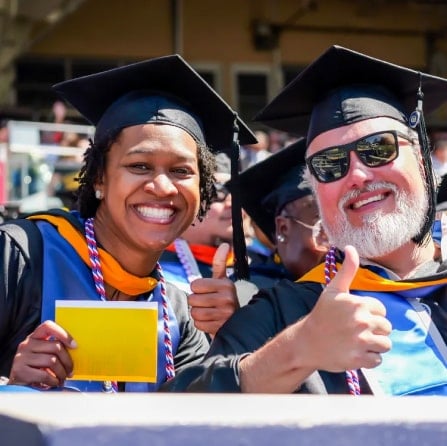
At National University, you’re part of a family. As a student, you’ll have the support of staff, faculty members, students, and alumni who will be there with you every step of the way, cheering you on as you pursue your goals.
Our network of 250,000 alumni is a large global community that provides our graduates with the professional connections to get a leg up in your new career.
Frequently Asked Questions
The growing business and education sectors are always in need of team members with foundational training in communications and business. Your career path could include a variety of bookkeeping, accounting, or computer support opportunities, as well as teaching assistant and paralegal professions.
General education studies provide essential self-development skills in literacy, math, business, and sciences that form a foundation for lifelong learning. They also help prepare students with the fundamentals necessary for more advanced education.
With an emphasis on literacy, math, business, and the sciences, National University’s Associate of Arts in General Studies degree prepares you for a lifetime of personal development, greater possibilities for more advanced education, and jobs that require a solid foundation in communication, math, and business fundamentals.
Career Opportunities in the General Education Field
- Bookkeeping and accounting
- Computer support specialists
- Preschool teachers and teaching assistants
- Paralegals and legal assistants
Employers of General Education Graduates
- Business, government, and non-profit accounting departments
- Computer support centers
- Public and private education providers
- Law firms, corporate legal departments, and government agencies
Yes! National University has always been dedicated to meeting the needs of adult learners. The Associate of Arts in General Education can be completed online, so you can study when and where it’s most convenient for you.
You will engage with faculty weekly and participate in discussions with faculty and classmates through online discussion boards. Quizzes and exams are completed online, and you submit your papers or homework directly to your professors through the online portal.
Additional Resources
Program Disclosure
Successful completion and attainment of National University degrees do not lead to automatic or immediate licensure, employment, or certification in any state/country. The University cannot guarantee that any professional organization or business will accept a graduate’s application to sit for any certification, licensure, or related exam for the purpose of professional certification.
Program availability varies by state. Many disciplines, professions, and jobs require disclosure of an individual’s criminal history, and a variety of states require background checks to apply to, or be eligible for, certain certificates, registrations, and licenses. Existence of a criminal history may also subject an individual to denial of an initial application for a certificate, registration, or license and/or result in the revocation or suspension of an existing certificate, registration, or license. Requirements can vary by state, occupation, and/or licensing authority.
NU graduates will be subject to additional requirements on a program, certification/licensure, employment, and state-by-state basis that can include one or more of the following items: internships, practicum experience, additional coursework, exams, tests, drug testing, earning an additional degree, and/or other training/education requirements.
All prospective students are advised to review employment, certification, and/or licensure requirements in their state, and to contact the certification/licensing body of the state and/or country where they intend to obtain certification/licensure to verify that these courses/programs qualify in that state/country, prior to enrolling. Prospective students are also advised to regularly review the state’s/country’s policies and procedures relating to certification/licensure, as those policies are subject to change.
National University degrees do not guarantee employment or salary of any kind. Prospective students are strongly encouraged to review desired job positions to review degrees, education, and/or training required to apply for desired positions. Prospective students should monitor these positions as requirements, salary, and other relevant factors can change over time.
Back to top