
When you have a difficult question, it’s always best to turn to a subject matter expert for answers. In our blog series, Ask An Expert, National University faculty take turns answering challenging questions in their areas of expertise.
In this post, we put the focus on family involvement in early childhood education. We asked Professor Susan Ferguson of the Department of Early Childhood Education at National University to share a few insights on how families make a difference in classrooms. Ferguson has been with the department since its inception and is a certified core adjunct faculty member.
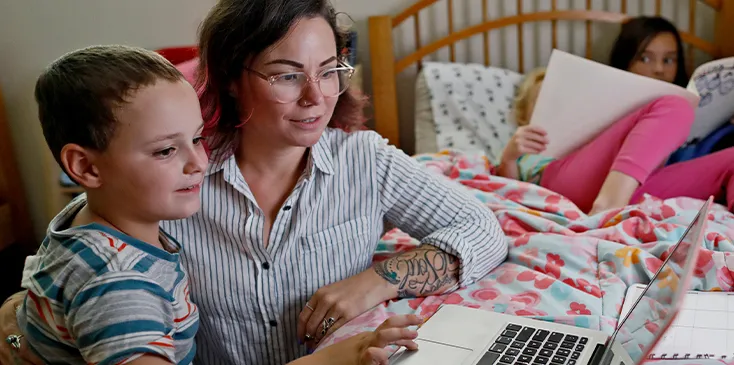
When parents come into the classroom two things happen, Ferguson says. Teachers learn about a family’s culture, and the family sees what a child is learning. This two-way street is a big win for the child’s development.
Ferguson says that student teachers seeking a degree in early childhood education need “to understand their own cultural biases and become aware that families are going to expect their infants to be fed and carried and put down for naps in the same way that they do.” Practices in the childcare setting may be very different from what the family does at home.
She explains that new teachers may feel defensive when parents come into the classroom and ask a lot of questions, but it’s important to have these interactions. “It’s not that families don’t trust the caregiver. It’s that they want to make sure that their child is taken care of the way that they prefer. Some of these families don’t even really know. They’re first-time parents.”
What Is the Importance of Family Involvement in Early Childhood Education?
When parents become involved in early childhood education, it is more likely that they will also be later involved in kindergarten and throughout the school experience. Ferguson says when parents learn activities and routines at school, they can continue them at home, which strengthens a child’s brain development.
“They say that practice is what causes our brains to pattern, so if families are involved in the activities that the children are experiencing in the classroom, they’re going to have a much stronger framework to build their knowledge.”
Ferguson stresses that parents’ own skills increase when they are involved in the early childhood classroom. “Not only is it essential for the children to have this consistency, but it’s valuable for the parents because it shows them that they can be active participants in their children’s education.”
National University’s bachelor’s degree in early childhood education operates on the belief that families make a difference in their children’s classroom throughout the entire education cycle. “The parents need to be involved in what’s going on in their child’s world, their child’s education, the school itself,” says Ferguson, “and this is only going to benefit the child and the family as the child moves into elementary school classrooms.”
When parents are not interested in or resist classroom participation, Ferguson says she advises teachers “to slowly but surely get the parents to understand how important it is for them to be involved.” Teachers can send home a small activity or book so the child can practice what they’re doing at school, again strengthening brain structure. Teachers can also send digital newsletters, photos, and offer parent meetings.
“What’s really cool about having the newsletter sent out through an email is that even the co-custodial parent who isn’t picking the child up or dropping the child off, who only has the child on weekends, can get a copy of the newsletter too,” she says.
If parents resist involvement completely, Ferguson’s advice to teachers is to accept the situation. “There could be issues that parents are not willing to talk about that prevent them from interacting the way the teachers would like them to interact. It could be cultural, that the families believe that it’s the school’s job to educate their children and that they don’t need to be involved.”
To prepare them for whatever level of parent involvement they may encounter in the classroom, students at National study a variety of approaches to parent-classroom interaction throughout their coursework.
Early Childhood Education at National University
The sequence of courses for National’s Bachelor of Arts in Early Childhood Education typically includes courses in Ethics, Early Cognition, Language and Literacy, Emergent Curriculum, Nature and Numeracy, and Play as Pedagogy.
Students who study for online degrees or who attend class in person must complete field studies for each course. Students visit the same early-childhood education center to carry out interviews, observations, and other assignments Students write about their field experiences as part of their coursework. This in-person contact is crucial, Ferguson says. “It’s mandatory that they go out in the community. They can’t just do it by phone. They have to actually go and talk or observe.”
For more information about National University’s Bachelor of Arts in Early Childhood Education (BAECE), available both on campus and online.


