

Research by the National University reveals emerging healthcare career opportunities at the convergence of healthcare, AI, innovation, technology, and leadership. The job market within the Healthcare and Social Assistance experienced substantial growth in the last decade and is rapidly changing.
“As technology advances, so does the demand for professionals, bridging the gap between AI capabilities and vast healthcare needs”, explained Linda Travis Macomber, Associate Professor at National University. What matters for most healthcare professionals is to provide care, “the how (in person or virtually) is secondary,” underlined Macomber.
These transitions create many emerging roles and careers at the intersection of generative AI, digital innovation, and healthcare. Our research shows that more jobs are now involving AI or VR activities and some positions, like the mental health professional, are seeing a real change in how they work.
Remote Work Opportunities
Mental health professionals lead in remote/hybrid positions, with 19.4% of job listings, highlighting this sector’s adaptability to remote work setups.
- Nursing and general physician roles also show significant remote/hybrid representation at 17.8% and 14.1%, respectively. They can work remotely, conducting patient consultations through video conferencing, monitoring their progress, and ensuring thorough follow-up.
- Specialized roles and administration also demonstrate notable remote opportunities, with around 13% each.
AI and VR Integration
Over 1 in 5 remote job openings involve AI or VR activities.
- All research-related positions involve AI/VR activities, underscoring the increasing integration of these technologies in healthcare research.
- Half of the positions related to data science or products involve AI.
- Data science is the category with the most job openings involving AI, followed by product and Research.
- VR-incorporated jobs, particularly in fully immersive therapy sessions, are prevalent among Mental health providers, indicating a progressive adoption of technology in mental healthcare.
- AI enhances patient care and generates numerous career opportunities by bridging the gap between AI capabilities and healthcare needs.
- AI in healthcare shows promises to advance new frontiers in clinical decision support, care delivery, patient and provider communications, and accelerated drug and treatment discovery, explained Macomber.
Career Opportunities and Emerging Role
Around 18% of remote job openings are related to coding, data science, or product roles.
- Coding jobs, while frequent in healthcare, do not typically involve AI usage, despite being an ideal field for automation.
- Roles related to product design and research are less common in remote healthcare job listings.
- New roles are emerging, ranging from Analysts to Leaders in Healthcare Innovation, requiring a blend of technical and healthcare expertise.
Job Openings Trend
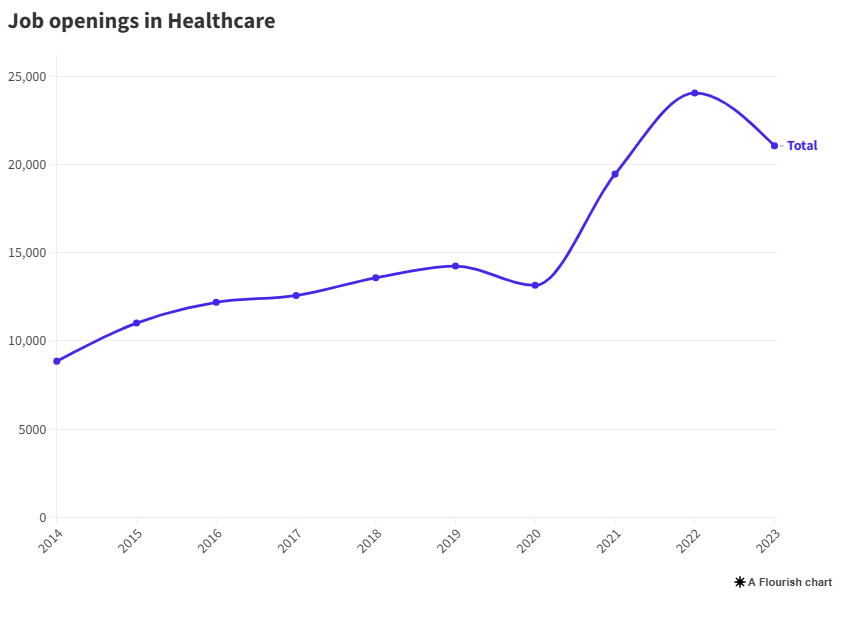
The number of job openings in the Healthcare and Social Assistance sector has more than doubled since 2014, showing consistent growth.
- Significant spike in 2021: There was a notable spike in job openings in 2021, nearly doubling from the previous year, indicating a substantial increase in demand for professionals in this field. The year 2022 marked the highest number of job openings in the provided data, reaching 24,047.
- In 2023, there was a slight decrease in the total number of job openings compared to the previous year.
Salary Variations
There are significant variations in average salaries across different job categories. Specialists have the highest average salary of $328,319, while coding roles have the lowest average salary of $66,817.
- Most job offerings related to AI or VR offer lower average salaries than positions without mention of those activities, except for Product and nursing positions.
Methodology
Job listings were obtained by searches of remote healthcare positions within the United States. A targeted search was also conducted within Indeed and on Google to find medical jobs specifically including artificial intelligence or virtual reality, which may include some on-site positions. AI/VR positions may include listings for companies creating AI/VR tools for medical applications and may not directly involve the applicant interacting directly with the technology.
Accountants, sales, marketing, IT, and other developer-specific positions were excluded. Salary data is based on rates listed within job postings when available. Hourly, daily, weekly, and monthly rates were calculated to reflect an annual salary that assumes full-time employment. Learn more about AI Statistics and Trends.


